
THE CUSTOMS, CULTURE AND LIFESTYLE OF THE MAASAI
*(Full credit for this information is given to Mr David Read – author of Barefoot over the Serengeti).
(* see pages 167 to 178 of my book, From the East End to East Africa).
When a traveler (a Maasai) arrives at a manyatta, he is greeted and, if it is not known, he is asked what his age group is. He is then directed to a house belonging to the wife of a man of that age group or, if there is no one in that category, to that of a man in the next group but one up from his own. Failing that, he goes to the house of one of the next group-but-one below him. If there is only one house he is qualified to enter in that manyatta, and if it is already occupied by other guests, he will double up with them. Still, the first guest to arrive is the one who will receive priority.
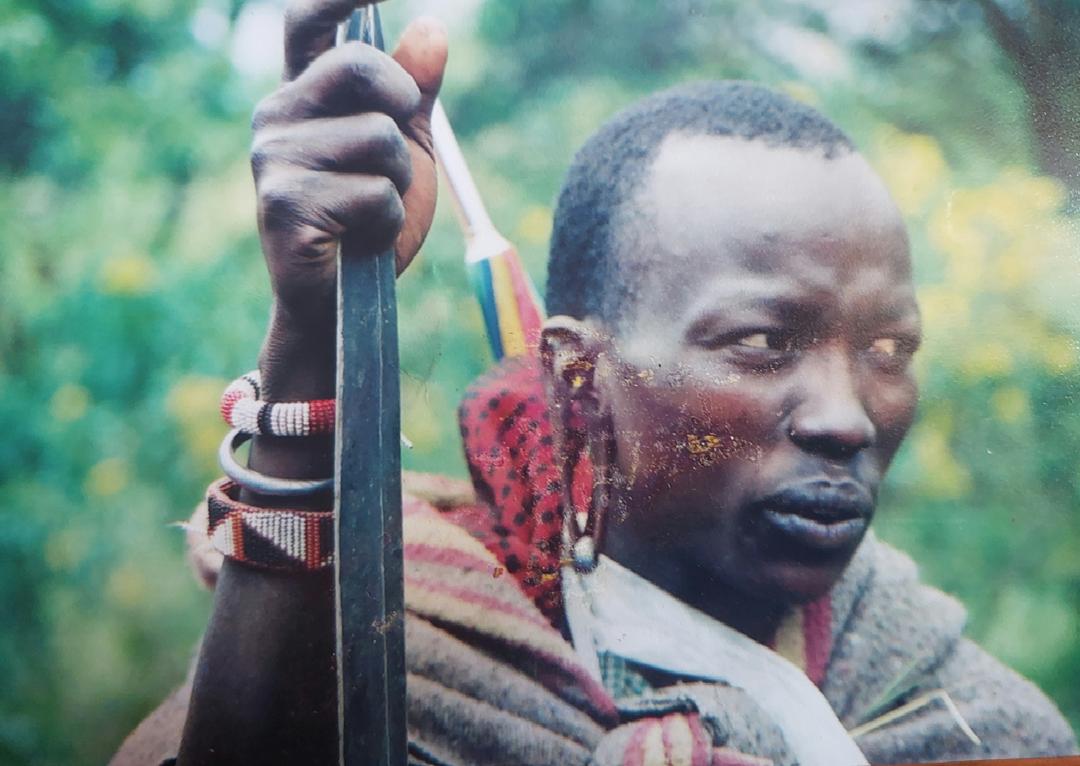
Once the house in which he is qualified to stay has been decided, the warrior will stick his spear in the ground outside the door. When he enters, the husband, if he is present, will sit and talk to the visitor and, after eating, will leave to seek accommodation within the house of one of his other wives, allowing the guest to remain with this wife for the night. There are two ‘rooms’ in a traditional Maasai hut; one is large room just big enough to contain a ‘double’ bed, the woman’s clothes, gourds, personal belongings and valuables, and the smaller room which contains a single bed, the small cooking fire and various pots, utensils and gourds, etc. The beds are made from buffalo or ox hide (leather) stretched over a low wooden frame. It is entirely up to the wife whether she wants the guest to share her bed or not. If she does, she will invite him to her bed, which means intercourse will take place; if she does not want him, she will tell him so and he will sleep alone in the large bed. A Maasai man is not permitted to make a woman pregnant unless it is his wife; therefore, just as in the case of layonis and endito or the asanja couples, coitus interruptus is practised.
But I want first to talk about the Maasai males and their place in the tribe.
The young African boy is much more disciplined in the customs of his people than would be a European child; on the other hand, he has much more freedom. A Maasai boy, for example, will never talk in the presence of elder males unless invited to do so. He will stop whatever he is doing to greet an elder male, and if told to do something he does not like doing he will nevertheless not hesitate if the order has come from an elder male (this does not always apply in the case of elder females). Among his own age-group, the Maasai does as he pleases: he can swear, fight, practise and play sex games, and generally do whatever he wishes, and no disapproval will be shown – in fact he will be encouraged.
The boy is used for any manual labour that may be required and is never pampered. He, therefore, learns fast, and the competitive spirit is instilled at a very early age. A boy of nine will know what herbs one needs for the treatments of various cattle ailments and where to find them, and he becomes proficient in animal husbandry. He knows what wood to use for roasting meat to bring out the best flavour, and which plants and berries are edible. He also knows how to approach dangerous animals and can use a spear to protect his herd against the smaller predators. Until circumcision, the young Maasai male is known as a layoni and from an early age is given small chores to perform. They call the young girl an ndito until her circumcision, whereupon her title becomes siangiki.
During this period of the children’s lives they are treated by the menfolk as unimportant and of no particular consequence, especially so the young layoni, who must be used but not considered except when he is working – looking after calves initially and later the cattle and sheep. He is not officially permitted to take part in any activity of sport or sex, but what he does on his own and away from the eyes of the elders, provided it does not in any way show disrespect, is his own business. He is, however, expected to be efficient in these activities when the time comes for him to prove himself.
The ndito is slightly different in that when she reaches an age of approximately two years before puberty; the moran (warriors) begin to take an interest in her. She then becomes a very important person and is considered to be ready for sexual activity; which is accepted by all as being correct, on condition that she does not have any sexual contact with a layoni, who is considered to be unclean. This, however, is often not the case as it happens that a girl may already have a long-standing friendship with a layoni before any moran became interested, although frowned upon by morans and elders. Few girls, if any, reach the age of ten as virgins.
The layoni, who has been brought up in the belief that sport, bravery, wealth and sex are the only things in life that matter, starts his sexual adventures at a very early age and invariably has a number of ndito girlfriends on the quiet, and can call on them behind the scenes.
During all this time, the young layoni learns from his own experience the skills of livestock management. He has become a competent herder, can diagnose animal diseases and knows their treatment. He is also able to castrate steers and slaughter animals for food. He can deliver a calf in a difficult birth without help; he knows how to behave at the different stages of his life, and what his responsibilities are towards the tribe. He has also taught himself the art of combat against wild animals and other enemies.
When the layoni has an opportunity of proving himself amongst the other layonis, he will do so, and in an emergency where there are no morans nearby he will also step to the fore; so from time to time his abilities come to the notice of his elders. For example, during his older years as a layoni, while out herding, the cattle may be attacked by predators. Normally he would have to send for help from the morans, and this would be considered the correct action to take. On the other hand, should he deal with the situation himself successfully, it would be to his credit. Often in an attempt to prove his worth a boy is killed. He will try to achieve recognition not only in the field of battle but also on the sports ground and with his favours amongst the endito, any exceptional feat again going to his credit. When the time comes for circumcision and the choosing of clan and group leaders, these points will be taken into consideration. All this is extremely tough for him as he is still, in the eyes of the morans and elders, of no consequence.
The next stage is his circumcision, and this is a very big event in the life of the Maasai male. It usually takes place between the ages of fifteen and twenty-three. He is either called by his father to be told that he is now ready for circumcision, or if he feels himself that he is ready and his father has not broached the subject, he may go to him and suggest it. Following the circumcision, he becomes a moran.
Next, I want to talk about the females of the tribe. The Maasai girl is treated and behaves, in much the same way as a boy until she is old enough to carry out small chores. She then becomes an assistant to her mother, while the boy, as soon as he is old enough, goes out herding the livestock.
One of the girl’s first duties is to gather up fresh cow dung to repair her mother’s house. After a while the girl child is taught to split strips of olive wood for cleaning out calabashes, and to collect cows’ urine for washing out the calabashes used for fresh milk. She also helps her mother milk the cows and later is taught how to assist in the building of a house, which is always a woman’s job.
As soon as the girl begins to show an interest in boys, usually at about eight or nine years of age, she starts to go off with the layonis and practises sex play. So when she is ready to make love with the morans, aged about eleven to thirteen, she is no longer a virgin.
If she decides she likes a particular moran more than the others, she asks his friends to invite him to drink milk with her on a certain day, in a ceremony called ngibot. She informs her mother she wants to have the ngibot, and some milk is set aside for two or three days beforehand. All the morans and endito then dress up in beads and other finery, and smear themselves with red ochre before entering the manyatta. They eat the now curdled milk and dancing begins. An older ndito, who has already proved her worth to the morans, is then chosen to perform the ngibot ceremony. A calabash of milk, previously treated with olive ash, which makes it stay fresh for several days, is presented by her to the chosen moran and placed at his feet. When he has drunk all he can, he leads his new sweetheart to a hut, followed by the other young men and girls. They spend the night making love and are both now known as asanja.
A moran may have as many as fifty asanja at one time, and this applies to a girl too. An asanja always has priority over other girls, and the girl will remain the asanja of a moran until she marries. A situation can arise when a moran is so popular with the girls he has a number of asanja in the same manyatta. This state of affairs sometimes leads to difficulties, so he is permitted to take his friends along to help him. They all share one bed, which can take up to eight people, but each person will remain with the same partner for the night although they may change over the following night.
After the creation of an asanja association, two further associations can evolve in the same ceremony. The first is the choosing of a girl known as oldipet. This girl becomes next in priority after the asanja. The second is olgiloti, where another girl – the third in line -is chosen. These two girls can change over their positions by mutual agreement, but the asanja retains her superior status until she joins her husband in marriage. This husband is very rarely the asanja moran to whom I have just referred. Sometimes a girl may marry her asanja, but this is not common, as her father has usually made prior marital arrangements for her, when she was still a small child.
When a moran visits a manyatta where he has an unmarried asanja, she will drop everything to spend her time with him – that is, of course, if she has not already made an arrangement for that day with one of her other asanja. What is so amazing about the asanja association is that there do not appear to be any jealousies, provided it adheres to the rules of the game.
After the girl’s marriage she may still associate with her asanja, but he no longer has any special claim on her, and he now has to follow a different set of rules.
Marriage negotiations for a girl are often entered into between two fathers before she is born, and the bride price paid then too. If the baby is not a girl, the arrangement can be carried on to the next pregnancy of the same wife or even to that of another wife of the same man. A girl, though bound to the husband her father chooses for her, does not become his wife, in fact, until after her circumcision when she will go to join him.
As soon as a girl starts to menstruate she is considered to be ready for circumcision (removal of the outer labia and a demi-clitorectomy), usually performed by her grandmother. She herself has no say as to when it will take place as her mother will decide for her (except if she were to become pregnant, when, as mentioned above, she would be circumcised immediately) having consulted other mothers with daughters of approximately the same age. The matter is then discussed with the father who provides the wherewithal for the ceremony, which differs only in some details from that of a boy’s circumcision.
After completion of the circumcision, the girl remains in her mother’s hut for four months, during which time she is fed mainly on meat and fat. Both men and women visit her, but no one may touch her bed except her mother, who is also the only one to prepare her food. Her betrothed is present on the day she is due to leave the hut, but first she is shaved, her hair having been allowed to grow during her confinement. Now every particle of body hair is removed. Her beads and adornments returned, her mother helps her to look as beautiful as a bride should, and she is then presented to her husband. A siangiki will usually keep her head shaven from now on.
On her arrival at her husband’s manyatta she is taken to her mother-in-law’s house where a party is already in progress. As soon as the sun goes down one of the prominent elders makes a speech, which is purely customary and part of the ritual. In it he tells the husband that he will be left alone on this night to enjoy his bride. He must thereafter never complain that he had not had the pleasure of sleeping with his wife for one night. The party disperses and the couple are left on their own. From now on the husband has the opportunity of sleeping with his wife only from time to time as he has to follow the Maasai code of hospitality towards his own age-group and share his wife accordingly.
If her husband is not yet an elder, the young wife may live with her mother-in-law for five or six years, depending on how well the two women get on with each other. Otherwise, she may build her own house. Women do all the work of constructing a house, and although it is known as the husband’s house, the woman is in fact head and owner of it.
 FROM THE EAST END TO EAST AFRICA - Copyright: Steven James Foreman.