THE TWENTY-YEAR GAP
(This essay, condensed and pertinent, and NOT chronlogical, fills in the 20-year gap between Part One and Part Two of my memoir, From the East End to East Africa.)
1971 – I join the British Army
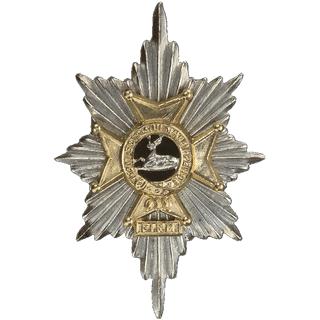
Because I was living in Nottinghamshire at the time, just a 30-minute drive from Sherwood Forest, I decided the regiment I would join would be the Worcestershire and Sherwood Foresters (1 WFR). Following the enlistment and selection process, joined my intake platoon at the Prince of Wales Division depot, at Whittington Barracks, Lichfield. I was now nineteen years old.
Generally speaking, basic training consists of twelve or fourteen weeks of very early mornings and very late nights, with, sandwiched in between these very unsociable periods of time, a succession of torments, turmoil’s, traumas and tortures cleverly disguised as character and fitness building exercises combined with specialised and objective training designed to convert a sloppy civilian into a ‘mean, green fighting machine’.
These programs consisted of a whirl of walking, marching, running, jumping, leaping, falling and almost dying in varying stages of dress, undress and distress, at progressively greater distances, carrying progressively heavier loads of equipment and with a progressively abject hatred of one’s Non-Commissioned Officers. Interspersed, or sometimes combined, with this physical abuse, were weapon training, fieldcraft, NBC Warfare training, ceremonial drill, lectures on military history, lectures on modern warfare, anti-Communist propaganda, daytime training exercises, night training exercises, grenade throwing, bayonet practice, anti-tank training, helicopter drill, aircraft identification, hole digging, shit shovelling, parade ground sweeping, uniform pressing, boot polishing, locker inspections, bed-block inspections, toilet inspections, more drill, personal hygiene inspections, religious instruction, sports and gymnastics, cookhouse fatigues, more drill, church services, guard duties, more boot polishing, block cleaning, floor scrubbing, office cleaning, more drill and signals training – to name but a few (oh, I forgot – more boot polishing)!
Our Training Team NCOs accompanied all of this, from dawn to dusk – and sometimes longer – with a continuous frenzy of screaming, shouting, bullying, threatening behaviour and physical violence – to a ‘fly-on-the-wall’ onlooker, it must have appeared like a scene from Hieronymus Bosch’s ‘green period’!
The culmination of all this wonderful back-bone strengthening stuff was a three-week ‘battle camp’ where all the newly acquired skills were put to test in the hostile and unwelcoming environs of the Brecon Beacons, where the sadistic training team were permitted to ‘let their hair down’ and punish and abuse us as if were the epitome of all that they despised in the world. Even now, if anyone even mentions Sennybridge Camp, it sends shivers down my spine!
After completing my basic training, I joined my Regiment, the 1st Battalion, Worcestershire and Sherwood Foresters (The Woofers) – and was immediately posted to the troubled streets of Northern Ireland. It was just three months after Bloody Sunday.
NORTHERN IRELAND
My first sight of the Emerald Isle was the Belfast docks.


It did nothing to endear me to Ireland, despite the reassuring presence of troopers of the Parachute Regiment and members of the RUC standing on every street corner and tactical observation point. It was only a few months after the infamous “Bloody Sunday”.
Belfast, however, was only our point of entry. Our destination was the city of Londonderry.
On arrival, we found that our barracks were actually the former BSR record player factory in Drumahoe, which had been partitioned off with sheets of plasterboard into dormitories, senior quarters, offices and the like. In my platoon’s dorm, I was allocated a bed space against the wall. Next to me was a new friend, Chris. We settled down quickly and soon established enough order to make for a comfortable night in our new ‘home’. The advance party had already been here for one month, taking over from the outgoing Regiment, so all systems were up and running. There was no reason to delay and just two days after our arrival, we went out on street patrol.
No amount of training can prepare you for your first encounter with hostile incoming fire. You are perplexed, unsure of what you are hearing. You cannot see your enemy – all you know is that your NCOs are diving for cover and shouting commands. Bits of concrete are flying from the pavement in little explosions of chips and dust and you throw yourself into a doorway and start searching frantically for the source of the hail of fire. All this takes place in a matter of seconds. You have not even had time to notice one of your comrade’s stumble and fall. Even as your frantic, searching gaze takes in his prostrate body, arms have reached out and grabbed him, dragging him to safety.
The above was my Baptism of Fire. The casualty was my new friend, Chris. Six months later, in Berlin, Chris, now medically discharged from the Army, came to visit us, jokingly yet somewhat cynically displaying his new prosthetic limb. His leg had been amputated just above the knee.
I am not going into details here; Londonderry at that time was filled with daily lethal bombings by the IRA. There were constant sniper attacks and ambushes on soldiers and civilians. There were riots in the streets; armed roadblocks and IEDs. Every corner on every patrol was a potential killing zone. Even when off-duty there was danger; the army camps or barracks were often the subject of drive-by shootings or RPG attacks. I was shot at several times and in constant fear of attacks or bombs. Some of the patrols I went on were in the streets of the city; others were way out in the country. One day my platoon and I was pinned down by a hidden sniper on a section of the Londonderry Wall. The sniper, firing from a concealed position opposite, even managed to shoot and destroy our ‘donkey ears’ periscope. After several soldiers returned fire, the sniper ceased firing and we were extracted from the position.
I rode ‘shotgun’ on the tailgate of soft-skinned Land Rovers or trundled through the night crammed into the back of a Humber ‘Pig’ APC or a 3-tonner Bedford truck.
The “troubles” of Northern Ireland, and the many and varied incidents that constitute that rather mild description of the situation, are known to most people of this era, due to the media coverage of the shootings, bombings, sectarian killings and other violent acts of civil war. Amongst the general public, however, this knowledge is a generalisation and any shock or horror felt by news of a particular incident is anaesthetised by distance or non-involvement; but for those unfortunate victims, survivors and relatives of victims of such incidents, the shock and subsequent emotional or psychological reactions are focused on the particular event that has affected them. A soldier, or any other member of the security forces in Ulster, is faced with both the general knowledge of what is going on all around him AND intimate involvement (whether aggressive, defensive or passive) in incidents on an almost daily basis (this statement is to be read in context with the period in which I first served in Northern Ireland – i.e. 1972). Even taking just one single incident, the soldiers or police involved will each, as individuals, have different actions, reactions and emotions, and, indeed, memories relating to that incident. This is one such personal recollection.
My platoon was patrolling a rural area of Londonderry near a small town called Limavady. We were called to respond to an emergency at the Police Station in the town. A car bomb had been detonated in a side street next to the Police Station, and a large hole had been blasted in the wall, causing severe direct and secondary damage. Apparently, the situation was intended to be a lot worse, but the car had not been close enough to the wall, and this had deflected a lot of the bomb blast back away from the Police Station. We were given various duties, which included clearing the area, sand-bagging the damaged wall and removing rubble and debris from the road. There was a charred shell of a wrecked car nearby, which we first presumed to be the remains of the car bomb. We were wrong; all that remained of the vehicle that had contained the explosives was the engine block and chassis, which was some distance away in a front garden. The rest of the vehicle had been literary blown to bits. The burned-out wreck we were looking at was actually the remains of a car that had been innocently passing by when the explosion occurred. There had been two passengers inside. The blast had been so great that their bodies had disintegrated and been blown out of the car in unidentifiable pieces.
It was one of our duties to help the police check out other damage caused.
At a big old house opposite, the blast had taken out the front windows, channelled its way across the living room, through the doorway, down the hall, tore through the kitchen, blew out the kitchen window, continued down the garden, and knocked down a garden shed. Every window in the house (and indeed all the houses around) had been shattered; upon following this trail of destruction, sifting through the broken ornaments, splintered doors and fallen paintings, I came at last to the wrecked garden shed. Some kitchen utensils had been carried this far and were mixed with the garden tools and plant pots strewn around the lawn. I saw one item I did not recognise. Upon examination, I found it to be the buckle of a car seat belt, still attached to a charred and melted length of nylon strap. Stuck to the metal of the buckle was a strip of burnt human flesh.
***
Towards the end of my three months’ tour of duty, Brigade HQ asked for volunteers to train as Dog Handlers, to help man the controversial internment camps that were in operation during this early period of the renowned “troubles”. The camps were designed to imprison IRA terrorist suspects and were run by officers of HM Prisons, guarded by British soldiers, and patrolled by war dogs and their handlers.
I, along with three others from my battalion, volunteered for this new challenge.
We returned to the UK mainland, and to the Royal Army Veterinary Corps HQ in Melton Mowbray. Whatever else I felt about leaving the streets of Ulster, I was thrilled at the chance to work with animals. We had intermittently had a dog at home since I was about three years old. I love dogs, and to be trained by the RAVC to care and handle them was an opportunity not to be missed.
The training was intense, with a lot of classroom work supplementing the actual physical interaction with the dogs.
When the course finished, I was immediately posted back to Northern Ireland, where I was attached to the dog section of the Royal Green Jackets, stationed at Magilligan Camp – an internment camp in the far north of County Londonderry.
The dog handlers work rota (or ‘stag’ as it is known in the Army) was four hours on, seventeen off – which meant that one would eventually patrol every period of day and night. It was lonely work, especially at night: just me and my dog, walking the perimeter fence that stretched across the wild and windswept moorland, in places over half-a-mile from the lights of the inner compound. However, the dogs, all German Shepherds, were marvellous companions, not easily distracted from their alertness. They were trustworthy and faithful – and very well trained. During one break-out attempt, one dog, by the name of Dutch, chased, rounded up and escorted back to camp, almost single-handed (pawed?) five escapees; forcing each one back, one-by-one, to the close vicinity of his handler, Bert, who held them at gun-point while Dutch disappeared into the darkness to search for the next one. In the meantime, other soldiers were on their way to Bert’s location to assist in the capture.
My dog, Nip, was also well trained, and with a barely discernible signal from me, would soon deter any non-dog section NCO from reprimanding me for sloppy dress or whatever. A quick glimpse of Nip’s bared fangs, bristling fur and flattened ears, and the reprimand usually deteriorated quickly ending with a hesitant, “…and don’t do it again. Now, as you were…” (Sloppy dress was something I abhorred, yet as a Dog Handler, it was fun to try.)
Dogs, like all domestic animals, require a lot of care and attention if they are to lead happy, healthy and fulfilling lives, whether as house pets or in an active working existence.
The dogs we took over upon our arrival at the internment camp (it shall remain unidentified, for obvious reasons) were, of course, already trained – and very ferocious. However, so well-trained and intelligent are they, they can tell immediately, by his actions and body language, if the person entering their kennel is a dog handler; in which case he is permitted to enter unmolested and ‘take over’ the dog, or if the interloper is considered a threat (or dinner!) and therefore unwelcome and the subject of an immediate and ferocious attack.
The term ‘dog handler’ is the most suitable and simple combination of English words with which to describe such an occupation – however, because of the curious nature of the relationship between the animal and the human, the term’ co-worker’ is more apt. A trained Army security dog – or ‘War Dog’ as these particular canines are classified, will not work with or respond to any person who is not trained to be a handler – in exactly the same way in which an untrained dog will fail to obey the shouted, frustrated commands of its master, no matter how familiar that person might be with the verbal commands and other signals used to control dogs. It is for this reason that very experienced dogs are used at the RAVC depot to ‘teach’ the recruit handlers all the tricks of the trade.
I remember one embarrassing moment during a training session known as ‘man work’, where a protectively suited ‘escapee’ was running across an open field in his bid for freedom. I shouted the customary “Halt!” command three times, followed by the warning “I am about to release my dog!”
The escapee continued his flight. I unclipped my dog’s leash (the dog was a huge black German Shepherd named Pancho – quite a well-known dog in dog-handling circles), and, following a pregnant pause where I tried to recollect the proper word of command, shouted “Get him!”
There was no response from the dog, although I could see he was poised like a coiled spring.
I tried again, “Go boy!” Pancho just looked over his shoulder at me, tongue lolling nonchalantly. Suddenly, it came to me, “Attack!” Pancho was off like the proverbial bullet and within thirty seconds had caught up with the now distant absconder, grabbed a flailing arm and brought him down in a tangle of limbs, dust, and grass-cuttings.
The dog knew, of course, exactly what was expected of him and had performed this exercise many times before – but he was training me and had waited until I got it right.
Because our dogs in Ireland had little opportunity to chase escapees (there were a few), ‘man work’ had to be incorporated into the weekly routine of ‘in-service training’ that was required to keep both dogs and handlers at a high level of readiness and alertness.
Grooming is an important part of daily care; it not only makes the dog look and feel good and allows the handler to discover parasites and injuries, it also helps form a close bond between dog and handler – a very essential part of the relationship between co-workers who rely on each other’s experience and co-operation to get the job done. With my dog, I felt so much more secure, so more confident, patrolling those dark, windswept moorlands, than I would have if my companion had been another soldier, who, by nature, would become complacent, bored, cold, easily distracted, etc., after hours of repetitive patrolling. Eventually, the chatting would start, followed shortly by the flare of a match as a forbidden cigarette was lit.
No such distractions with a dog, which would, even if his handler became tired or cold, remain alert enough for both of them.
Because of logistics and quarantine, and the way in which the Army is operationally in a constant flux of postings and emergency responses, Army dogs only remain with their appointed handler for the duration of the soldier’s posting – unlike the security dogs used by the British Police, who remain with the individual Police officer for the whole of its working life – and beyond.
I think all the soldiers I worked with in the dog section at that time felt the same sad reluctance when the time came to hand over their canine companions to the new handlers being posted in.
The dogs were well trained, but dangerous – even lethal (they were actually classified as a weapon) – but you became fondly attached to them, and at the end of my tour of duty, parting with Nip was as upsetting as discarding a well-loved pet.
I do not wish to dwell on Ireland too long, it holds too many bad memories – for soldiers and civilians alike, whatever side of the fence they are from, and the horrors, the shootings, the bombings, the loss of friends and colleagues, are all stories that have been told before – mine are no different, only the faces change. I left behind the street patrols and vehicle check points (VCPs), and riding ‘shotgun’ and border patrols, and covert surveillance and ‘black-face’ patrols and all those other duties that the soldier has to perform. All of them had their good moments – even funny or laughable at times – and their bad. However, my fondest memories of Ulster are the many lovely Irish people I met… and my dog, Nip. My most poignant memory is of a displaced and charred seat-belt buckle lying in someone’s back garden.
WEST BERLIN
Berlin was, then, an island of western ideology surrounded by a grey sea of socialism. The ‘corridor’; that now defunct umbilicus that joined West to West, was, like any other causeway, passable only as the ebb and flow of tide, in this case political tide, allowed. However, as a soldier of the occupying forces, one did not feel the sense of imprisonment that many of the residents of Berlin suffered; although the Wall was a constant reminded of our isolation and the potential threat on the far side. With the danger, excitement and sadness of Northern Ireland now behind me, I looked forward to fulfilling all those options and possibilities of diversity that the recruiting posters had advertised when I joined up.
While not freezing my arse off in a watchtower or on a windswept, snow-clad plain in Schleswig Holstein or some such god-forsaken place that the Allied Forces choose to send their men for battle exercises, I put my name down for every suitable or interesting course or activity that was posted on the Company and Regimental notice boards. Because of this, I ended up on a German language course, an equestrian course, and –best of all – a sniper’s course.
One of the activities that I went on, which had a hidden advantage, was a skiing exercise, designated “Snow Queen” (there is a person, tucked away somewhere in a dusty backroom of Brigade HQ, whose sole duty is to think up corny code names or designations for military exercises. What a vivid imagination he has!).
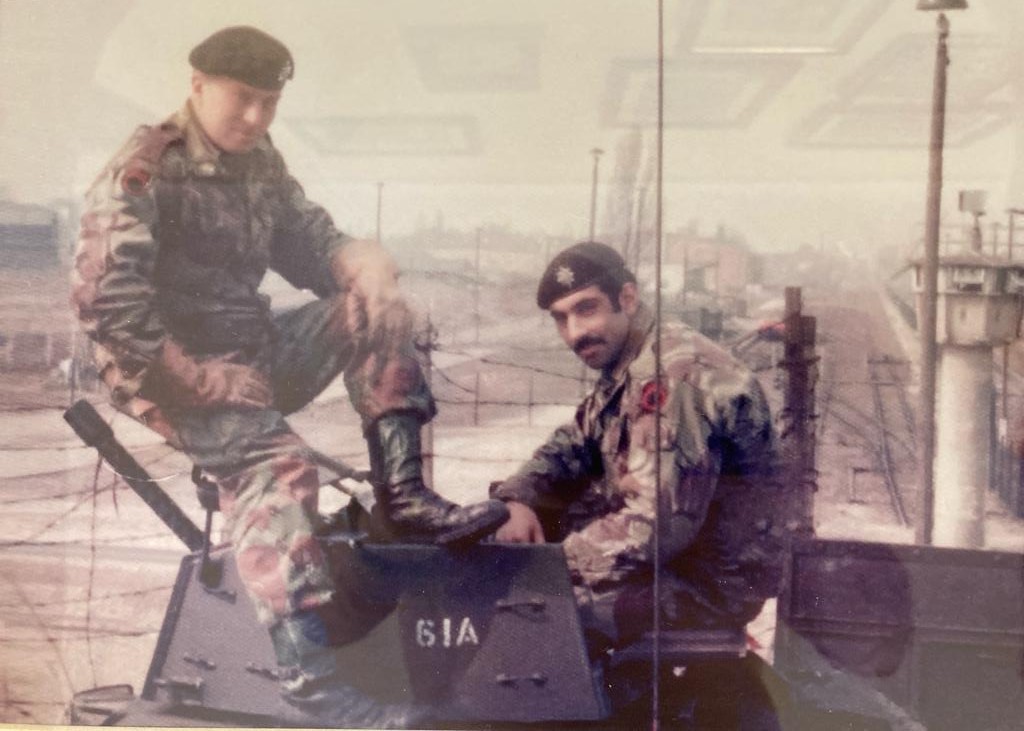
It was during this two-week, injury-plagued sojourn in the snows of Bavaria that I met a certain Captain of our Regiment, who was at that time Officer Commanding Reconnaissance Platoon. I struck up quite a rapport with Captain Wood (‘Chippie’, as he was known familiarly) après ski, the result of which was an offer of transfer from my rifle company to that of Recce Platoon once we returned to Berlin. I accepted of course: Recce Platoon, in my opinion, and that of countless other soldiers, is the ‘cream’ of many infantry battalions – lots of adventure, stripped-down vehicles, bristling with weapons, unorthodox uniform and camouflage, and, in Berlin, the duty of patrolling the Wall, wire fence and boundaries that separated West from East.
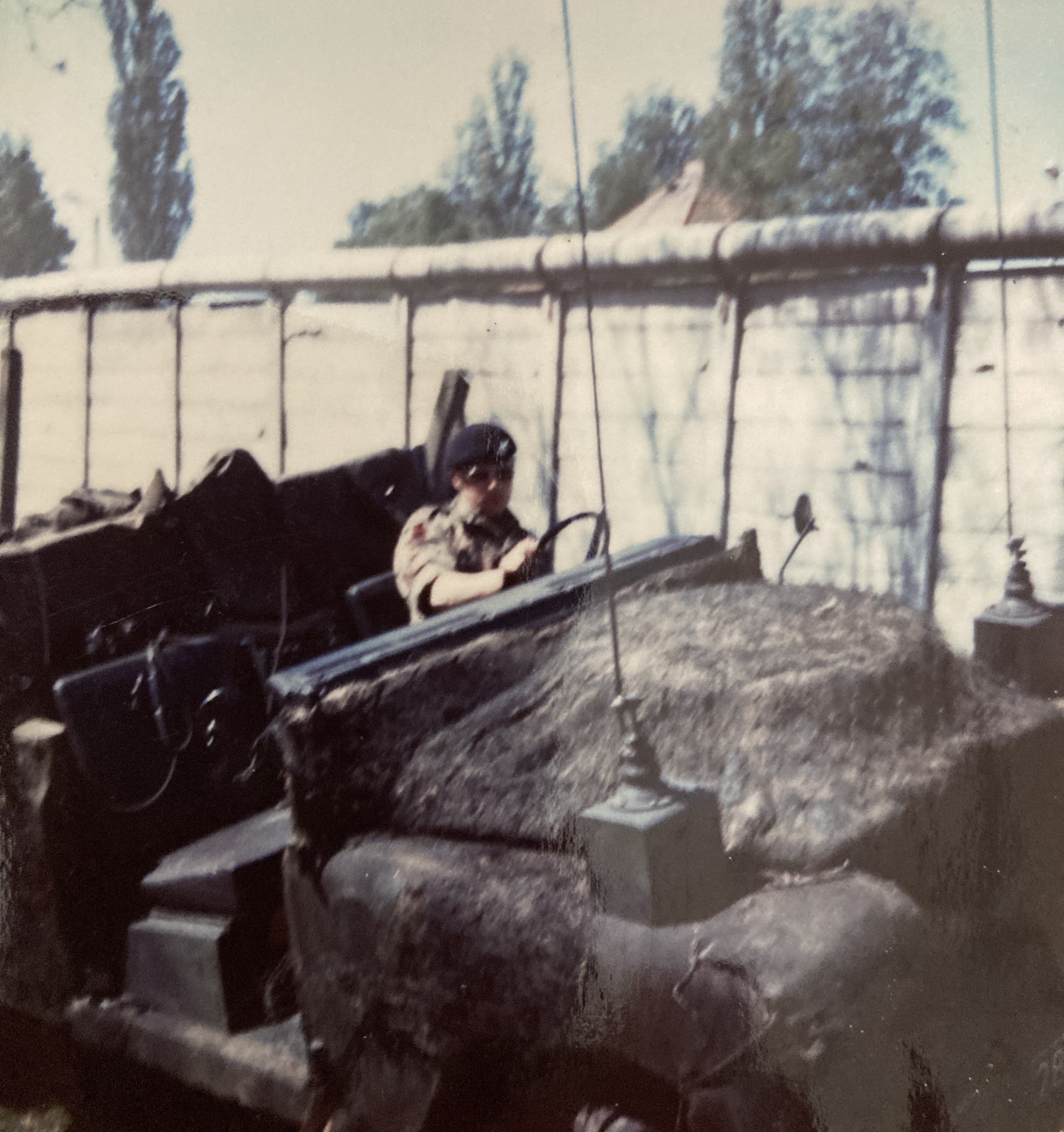
Subject to the Allied Forces rotas, and, subsequently, our Regiment’s timetable, many of my days were spent driving parallel to the various sections of the border within the British Sector. At the wheel of (and later commanding) either an armoured reconnaissance vehicle (a Ferret Scout Car, in this case), or a stripped and camouflaged Land Rover, I would, in the company of the rest of my section, drive out of our barracks, armed with weapons, food, cookers and other comforts, on a tour of duty that was a combination of serious patrolling and surveillance (this was, after all, during the height of the Cold War), fun, history, education, occasional excitement and freedom from daily Regimental routines. Of course, as a driver, I was forced to wear glasses nearly all the time now. However, once I realised, I was allowed to wear tinted aviator shades here (something not allowed in basic training or Northern Ireland) I rushed to the nearest civilian optician in downtown Berlin, dumped my despised black NHS ‘Buddy Holly’ frames and went Top Gun! I never looked back (!).
The border in Berlin was not all bombed-out buildings and death-strips. Some of our routes, in the British sector at least, took us through rustic villages, beautiful woodland, tree-lined lanes, and cobbled streets and along the banks of a huge lake. We would fry up some sausages in a woodland clearing, drink a cold beer or two in a village Gasthof, or share a joke and a Coke with some pretty frauleins on the grassy banks of a river. The Border Patrols were so appealing that I often volunteered for extra duties – if one of my mates wanted a weekend off or whatever. It was in Recce Platoon that I also honed my infantry skills to a higher degree than I had in my old rifle company. Tactical patrolling, surveillance, ambushes, sabotage techniques, and other skills were all part of our training. The Sniper’s course brought me into the world of special weapons, secrecy, camouflage, covert surveillance, and movement, and taught me to be an expert shot. Of course, in those days, the unit level sniper’s rifle was nothing compared to the purpose built 50cal Barret in use by snipers and SWAT teams today. It was a 7.62mm calibre, with a rolled steel floating barrel, mounted in the body and stock of the old Lee Enfield Mk VI and mounted with a modern sniper scope. However, I could, on an average day, still put five out of ten rounds into an eight-inch-square target at 1000m, and eight out of ten rounds at 600m. At any range less than that, I usually scored ten out of ten (all this with my Top Gun glasses!).
Another duty, in which I took part and enjoyed, was known as a “Flag Tour”. This involved a party of four soldiers (one officer and three other ranks) crossing into the East in a flagged staff car, wearing full No.2 dress, and, once there, visiting various areas of interest – including the city streets, the Soviet War Memorials and Graves, Hitler’s Bunker and Checkpoint Charlie. It was a pure “flag-waving” exercise, but I have no idea of its political significance or outcome. I do remember that nearly all of the normal East German citizens we tried to speak to were very reticent, and continually glancing over their shoulders, even during the shortest of conversations, which may have only been to facilitate the purchase of an item in a shop.
***
Spandau Prison: The name itself evokes a strange kind of horror. Now no longer in existence it was, during my tour of duty in Berlin and many years prior to that, the place of incarceration for one solitary and infamous War Criminal, Rudolf Hess.
It had been the policy of the Allied Forces, and the Soviets, for whatever obscure political reasons, to maintain a 24-hour, high profile, armed guard for the duration of the prisoner’s confinement at the prison. For a pre-determined allocation of time, each participating nation (i.e. British, American, French, and Soviet) would be the duty nation, and during this period, regiments were required, on a rotational basis, to provide a guard presence at Spandau. The frequency that a duty came around was such that it was not a foregone conclusion that every soldier would have to mount guard at Spandau during his regiment’s posting in Berlin. I, fortunately or unfortunately, depending on your perspective, performed two Spandau guard duties during my two years there.
It was not a pleasant duty, and most soldiers dreaded the forthcoming rota when their regiment’s time was due, hoping that they would not be chosen.
The uniform to be worn was an immaculate and oft-inspected No.2 dress, the best of best boots and a gleaming white rifle-sling and belt. For some peculiar reason, known only to the higher echelons, no gloves or greatcoats were permitted to be worn on duty, even in winter. When on stag, live ammunition was loaded into the magazine and affixed to the rifle, which of course in those days was the 7.62mm SLR. Such a sensitive issue was Spandau, that the slightest error or mishap by a soldier could result in court-martial.
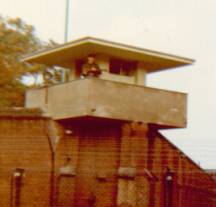
A very high brick wall, topped by guard towers situated at the angles, formed the long perimeter of Spandau. These towers overhung the wall and were reached by an iron ladder running up the inside of the concrete stanchion. Spandau was not symmetrical, yet it was possible to have visual contact with at least one other tower when on stag…except, that is, the dreaded Tower 3. Scene of several bizarre incidents and at least two rumoured “graveyard shift” suicides by soldiers of other nations, it was the object of much myth and legend. It was bad enough to be picked for Spandau guard, but to draw Tower 3… well, that was the worst of all duties. In one incident that I remember, a squaddie emptied a complete magazine through the hatchway of Tower 3. The gunfire naturally had the whole place in a riot. When the Guard Commander eventually got up into the tower, the soldier was just a gibbering heap on the floor of the parapet. Later, following his release from hospital, and before being sent off to Colchester nick, it was leaked to us that, in his statement, the soldier said he was firing at some dark, slithering creature climbing the ladder onto his tower, and the last thing he remembered as he ran out of ammo and passed out, was the thing still climbing towards him.
Because one mounted stag alone in the towers, and there were no radios, the only form of communication during the two-hour duty was the occasional thumbs-up to your fellow guard in the next visible tower. In Tower 3, however, there was no such comforting contact. One could not escape the loneliness by going inside to warm oneself at the small electric fire either; the whole of the stag was to be spent outside on the parapet. Not a problem during daylight; but at night, when the wind stirred the long, unkempt grass below you, and in the deserted buildings, who’s broken windows stared like black, empty eye-sockets, hanging chains swung slowly, clinking against each other in the darkness; and Rudolf Hess, imprisoned in the only wing of the establishment that was still maintained, began screaming from his cell window…then you could be in trouble.
I had a much closer encounter with Hess than mere vocal taunting.
As the new guard marched in single file through the grounds of Spandau, on their way to go on stag, it was customary to proceed through what had once been a well-maintained garden, and what was the exercise area for Rudolf Hess.
On this particular day, Hess, and his decrepit custodian – another old soldier engaged to monitor the prisoner – were taking exercise on a pathway that intersected our route. As we drew near, Hess began a feeble imitation of the Goose-step along his track. His performance was ill timed enough to bring him on a collision course with our file, and the inevitable meeting of paths occurred just as I was crossing the junction.
Our standing orders were clear: At no time were we to have physical or verbal contact with Hess, and eye contact were to be strictly avoided. I would have been able to comply with this had Hess not actually kicked me on the side of my lower leg, which caused me to stumble and automatically glance at him. He had stopped, and was just standing there, grinning at me.
I presume he was grinning, for his face had the appearance of a skull, and his sunken eyes were no less haunting than the empty windows viewed from Tower Three. Even as I was regaining my step and pace, I had to tear my gaze away from him with great effort. It was a bizarre and frightening moment: twenty-eight years after the war had ended, I was kicked by a Nazi War Criminal!
I am pleased, in one way that I was able to experience such a strange moment; and to have taken part in such a unique and historical guard ceremony.
However, I am glad it is all gone, along with Rudolf Hess. If not for him and the memories he evokes, then for the soldier who will not have to suffer freezing conditions, numb fingers, and hours of loneliness and the fear of court-martial for the most minor offence or mistake. So, he will not have to watch, through tired and night-blind eyes, the slinking shadows crawling towards his tower and disappearing from his view under the parapet, and stand, with bated breath, harkening for a footfall on the first metal rung of the ladder; so, he will not have to listen to an old man’s maniacal screams echoing across the dead ground towards the dreaded Tower Three.
WEST GERMANY
In 1975, I married a young woman, Jan who I had known for some years before joining the Army. She had a daughter, Zoe from a previous marriage.

In 1976, I joined the Queen’s Royal Irish Hussars, which was stationed in Paderborn, West Germany. The QRIH was a cavalry unit in the Royal Armoured Corps. Apart from a select few Regiments, such as those in the Household Cavalry and others that perform traditional ceremonial duties, the modern cavalry has swapped its horses for tanks. These can be either light or heavy, depending on the regiment and its current role in the theatre where it is stationed. My unit at that time, in 1976, was a Main Battle Tank Regiment and was equipped with the 60-ton Chieftain.
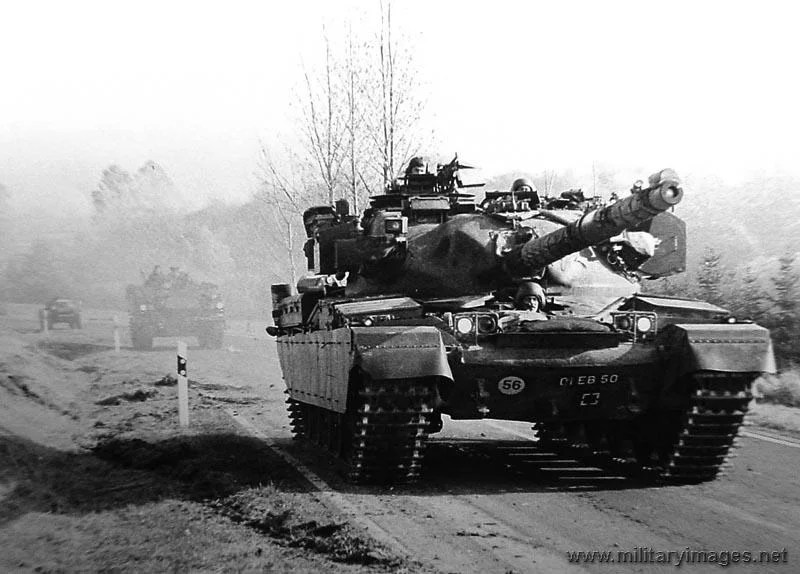
The Regiment was based at Barker Barracks, just outside of town, and it was here I lived while I searched around for a suitable flat, there being no Married Quarters available at that time.
On arrival at QRIH HQ, I was posted to ‘A’ Squadron. Because I was an experienced Ferret Scout Car and Land Rover driver, and because of my time in Recce Platoon, I was immediately placed in the Squadron Headquarters Troop (SHQ), which is equipped with such vehicles.

These are used, when the Squadron is mobilised, as a Reconnaissance unit, however, I was also required to become a Cavalry Crewman, and I therefore began to learn all the tank trades. Within months, I was qualified as a Tank Driver, a Gunner, and a Loader/Op (a radio operator who also has to load the main armament during firing). With promotion to Lance Corporal coming soon after this, my primary role was as the Squadron Second-in-Command’s (2i/c) driver – a role I thoroughly enjoyed (most of the time!)
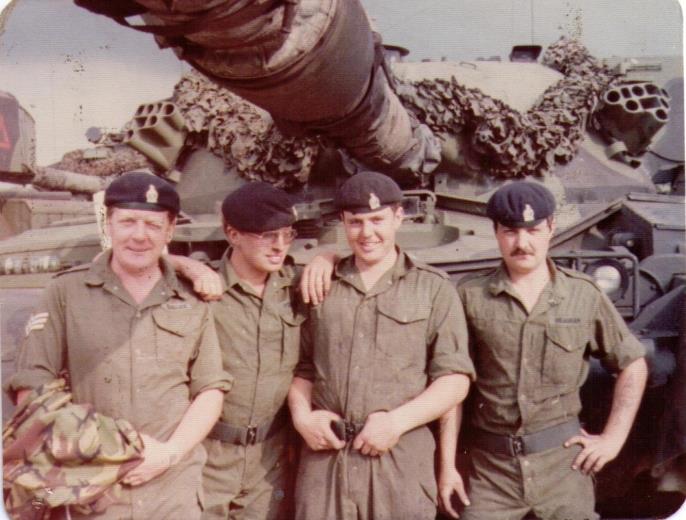
Driving a tank was great fun, and gave one a strange feeling of indomitable power. This was not only due to the immense size of the vehicle (12ft wide, 30ft long and weighing 60 tons when fully loaded) and its unstoppable ability to drive over all sorts of obstacles, but because, as a driver, you were isolated from the other three crewmen in the turret, who were busy plotting courses, sending radio messages, checking gun equipment, making tea or whatever. As a driver, this tank was yours. The Commander might tell you to go left, or take this road, or get to such-and-such a point, but you controlled it – you made it climb steep banks, roar through muddy fields, plunge into riverbeds or creep, relatively quietly, through thick woodland. Yet, as isolated as you were, you still felt the presence of teamwork. This camaraderie could manifest itself in such a simple act as a cheese and jam sandwich (with its attendant greasy fingerprints) suddenly manifesting itself next to your ear on the end of an excruciatingly stretched arm, worming its way through a small gap from the turret above and behind you. However, it could also have its adverse side. The turret (or Fighting Compartment to give its correct name) was warm, with humming metadynes, radio sets, red bulkhead lights, ancillary equipment… and the permanently simmering Boiling Vessel (the Bee Vee), which provided the endless cups of tea needed to survive Army exercises. Of course, when you went ‘tactical’ and the turret was ‘shut down’ with all the hatches closed, it could become oppressively hot, but there were ventilation systems that kept the filtered air circulating. In the Driving Compartment, there was no such heat source. Even when ‘shut down’ under normal weather conditions, it never got warm enough to be called uncomfortable. However, in winter (when it seems most of the manoeuvres took place), it was like a freezer cabinet. Even with non-regulation warm clothing on top of your combat gear, the restriction of body movement (other than the arms and legs motions required to drive the thing) meant that the cold seeped into your bones. Your toes – indeed your whole feet, became very numb and your fingers – even inside your gloves – petrified into immovable claws clamped around the metal steering levers. If you were ‘shut down’ in those conditions, then the situation was even worse. With the driver’s hatch closed, you had to recline the driver’s seat into a horizontal position, so that you were lying almost flat – with your headrest adjusted so as to push your face up against the rubber surround of your periscope sight above you. With the steering levers ratcheted into the corresponding position, you were virtually immobilised, and the cold and subsequent pain becomes unbearable and driving is a torture. It gets worse. Now take the above scenario, make it nighttime and go stationary and tactical – i.e. no engine, no noise, no movement – with frost forming on the metal surfaces, then you may as well be in a coffin of ice. And as you lay there, you promise yourself that, if you ever get out of this one alive, you will become a Gunner or Loader/Op. However, you do get out of it. Dawn breaks or the intercom crackles in your ears. You go non-tactical, unbatten the hatch, and stick your head out. Someone passes you a cup of steaming tea and a chip buttie – and then comes the order “Move out!” You fire up the huge Rolls Royce engine and the power throbs through the armour and up into your arms. The tank lurches out of the forest and snowbanks, shedding tree debris and camouflage, and roars into the bright winter sun. Once more, you feel the power and invincibility, and you are so glad you are not a Gunner or Loader/Op, stuck in the Fighting Compartment above (until the next time!).
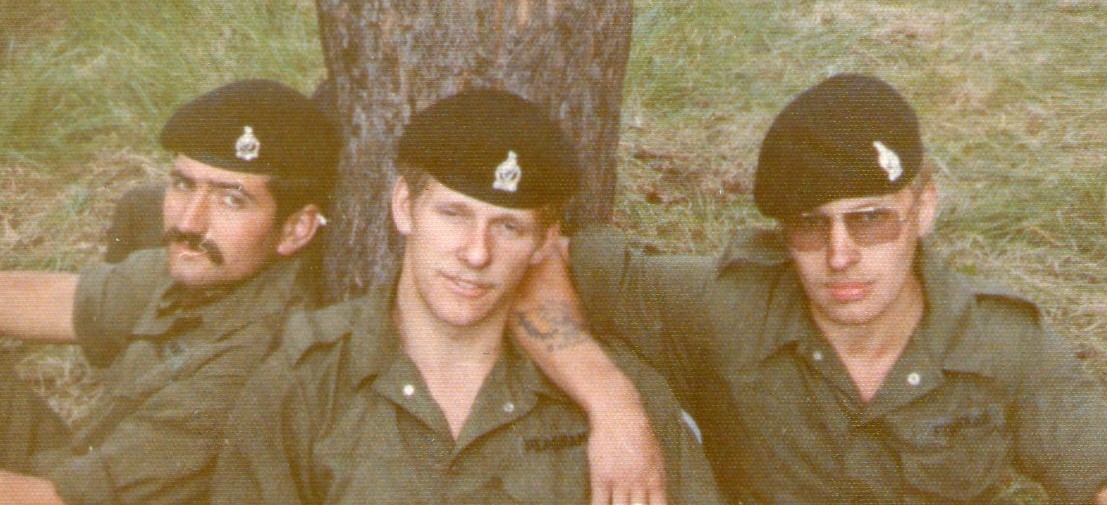
When Jan and Zoe eventually joined me in Germany, we moved into a private apartment above a bar in Muehlen Strasse, Paderborn. Walter Lange and his wife, Annaliese, owned the building. They were to become like surrogate parents to Jan and I, and like surrogate grandparents to Zoe (and later Zak). We actually called them Uncle Walter and Auntie Annaliese (although we used the German vernacular of Onkel and Tante).
The strangest thing about this relationship, and the one thing, over the genuine love and kindness they showed us, that makes it worthy of mention, was the fact that Onkel Walter, during WW2, had been a Captain in the Nazi SS!
Zak was born on the 30th June 1977, at the British Military Hospital, Rinteln (District of Hanover). I popped up there to see him pop out!
Several months after this event, we moved from Walter’s apartment and into an Army Married Quarter in Schloss Neuhaus, a few miles away from Paderborn town.
I spent the next two years running around Germany and other bits of Europe on a variety of training exercises and other gung-ho stuff. I estimate that I was away from home for about a total of eight months out of the year. This was a recipe for marital disaster.
On my return from a two-month Battle Camp in Alberta, Canada, I was seconded to the Regimental Police as Provost Corporal. This was a role I enjoyed and was another step on the ladder to the security-type work that awaited me, still unknown, in the future.
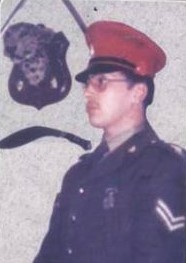
Not long after this, for personal marital reasons, unfortunately, I received a Compassionate Discharge and returned to the UK.
CONFESSIONS OF A PRIVATE EYE.
I had harboured, for some years – even during my military service – a hankering for work in the field of security. I do not mean employment as a uniformed security guard, but in the broader sense, which encompasses law enforcement and investigative aspects.
The job I had seen advertised in 1980, by virtue of its title, ‘Security Officer’, therefore, would not have normally appealed to me but the small blurb below the title mentioned ‘detection’. It was this word that caught my eye and enticed me to pursue the application.
I was invited to an initial sifting interview with the store manager of F W Woolworths, in Aylesbury.
My form of transport in those days was a Harley-Davidson motorcycle, so as I was going to wear my one and only suit and tie, I took a bus into Aylesbury.
I arrived on time at Woolworth’s large flagship store. It was then that I discovered that the common name for the job on offer was ‘Store Detective’.
My Army service record and ‘Exemplary Conduct’ was well received, and having spent a year in the Prison Service also stood me in good stead.
The store manager told me that I had passed the 30-minute initial sifting interview and would be called in for a second interview with the Regional Security Manager, Mr Bob Hill.
A week later, suited up once more, I jumped on a bus and arrived on time. After thirty minutes, I was told that Mr Hill was delayed and unable to make it, but I would be informed of the next date. I was disappointed, naturally, but waited with bated breath for the call.
When it came, I again donned my suit and tie and took the bus into town, and again after a wait of almost one hour was told that Mr Hill was still in court, in Reading, and would not be able to come.
I was seething inside, but what could I do, other than wait for the next appointment.
Fed up with wearing a suit and tire and travelling by bus, the next time I was called I went on my Harley, and entered the store office dressed in leather jacket and jeans and carrying an open-face crash helmet. I was a bit too pissed off with all the delays to be worried about anyone would think
Mr Hill was waiting for me.
Bob Hill turned out to be a really lovely bloke, and we hit it off from the first word. Bob was an ex-police officer who had been involved in security his whole life (he had been in the Intelligence Corps during his Army Service, prior to his thirty years in the police).
Bob explained that the image most people have of a store detective is that of a no-nonsense, middle-aged woman with a shoulder bag and sensible shoes, arresting little old ladies for forgetting to pay for a tin of tuna fish, or whatever. That may have been (and still is, in some cases) the correct image and requirement of the operative – before ‘shoplifting’ became a prolific crime perpetrated by professional thieves and its fundamental and true implications became fully understood.
‘Shoplifting’ is, as its perpetrator the ‘shoplifter’, is a ‘common’ word. It has no place in law or legal jargon.
For ‘shoplifting’ read ‘theft.’
For ‘shoplifter’, read ‘thief.’
For ‘shoplifters’ of course, there is the little old lady with a tin of tuna fish under her coat, but also the office clerk, on his lunch break, with the set of tungsten darts concealed in his rolled newspaper, or the highly respected dentist within electric iron hidden from view behind a bunch of flowers, or the young schoolboy egged on for a dare or threatened by a bully, with the bar of chocolate or toy car or copy of Penthouse in his school satchel, or the school teacher with ten music cassettes in his jacket pockets.
But, also there are the highly professional and motivated criminals who move into towns, sometimes as a team, and the space of a single day can remove several thousands of pounds worth of items – some as large as TV sets and refrigerators; professionals who will also defend their freedom, using bodily and armed violence, against anyone trying to apprehend them.
“The modern store detective,” Bob said, “is a law enforcement officer. He or she probably detects more active crime than the average uniformed police officer will ever see in his career- whose job is usually to prevent crime by his presence or to respond to a crime report. The CID and other investigative branches such as Serious Crime Squads and special task forces, through their network of investigation and information, can often lie in wait to prevent a crime and/or apprehend the perpetrators in the act. However, the modern store detective is constantly there at the point when the offence is going down. They have to deal, often single-handed, with the whole spectrum of thieves and put themselves at considerable risk of not only immediate violence, but also of later acts of revenge or other repercussions.”
“Oh, I understand what you mean,” I said.
“I do not wish to detract from the work of the police,” Bob said, “but I would like to put that old image of a store detective as an umbrella-toting matron firmly in its place – in the past!”
I nodded in agreement.
“So, how does this sound so far?” Bob asked. “Is the job something you like the sound of?”
“It certainly is,” I replied. “But what about training?”
“Yes, of course. I will train you on the law and company policy, and on arrest procedures and statement writing, and court procedures at Magistrate’s Court and Crown Court, and so on, but the actual work is really down to your own observation skills and common sense,” Bob said. “As I explained, this job is not the same as that of the old floor walker, as it used to be called. You will deal with staff theft, false accounting, staff and public collusion, back-shop shrinkage, short delivery, theft from delivery vehicles en-route, theft from cash registers and cash offices and myriad other staff-related offences.”
I was quite amazed at this information, and excited!
“You may have to deal public order offences, trespass, criminal damage, and threatening behaviour,” Bob continued, “you will operate the closed-circuit TV installed in the store, sweeping sensitive areas or videotaping suspect persons. Together you and I will plan unannounced purges on certain stores where their in-house disciplines have become slack, unsound or suspect., and carry out covert surveillance and night observations on loading bays, staff entrances, contractual cleaners and, unfortunately, uniformed security guards.”
Bob paused, and waited for a reaction.
“Wow! I had no idea! It sounds exactly the type of job I have been looking for,” I said.
“Well,” Bob said, “you have found it!” He reached forward and shook my hand.
***
Had I had known that, in the four plus years lying ahead of me in this job, I would suffer broken ribs, a cracked bone in my thumb, a broken nose, blackout by strangulation, two broken wristwatches, two pairs of broken spectacles, a torn jacket, paint-covered jeans, a threat on my life with a knife, hours of freezing-cold inactivity on rooftop surveillance’s, hours squatting concealed in a cardboard box in a warehouse, hours stuck in an office toilet watching a concealed camera monitor, and hours waiting at police stations and Magistrates Courts and hours of nerve-wracking cross-examinations in Crown Court – I would have still accepted it!
In one job alone, where I arrested a thief (and subsequently caused his partner to be arrested by the CID) over $1000 worth of goods was recovered, concealed in a multi storey car park where they had ferried it bit-by-bit after stealing from several stores in town. I had luckily caught him on what might have been his final theft of the day.
In another case, I chased a man up a fire escape, ran across two rooftops, jumped from the roof of a shop front to the street, and eventually – along with three uniformed police officers who had joined in the chase – apprehended him, relatively peacefully, in a public park, where we found electrical goods totalling $800 upon his person.
In another case, a couple of men, whom I had seen stealing cheap pairs of socks, ran off when I tried to arrest them. I managed to catch hold of one, who then threw me to the ground and kicked me so hard and repeatedly as to break two of my ribs. He was never apprehended.
A couple of years later when Bob promoted me to Area Security Manager, although my base was still Aylesbury, I had eleven other stores under my jurisdiction throughout the Home Counties.
I worked very closely with the CID on many cases and built up an excellent relationship with the uniform branches of most of the local police stations, with which I had almost daily contact.
During my second year at Woolworths, I began some part-time Private Investigation work. Initially it was just Process Serving for various law firms. The solicitors of these firms knew me quite well now by reputation and my many court appearances as a prosecution witness, and I had built up a good rapport with them. Most were quite willing to give me the work, which, for them, was time consuming and unpleasant.
***
When we advertised for an extra Security Officer to assist me at the Aylesbury store, I did the sifting interviews. Jan was the only applicant that stood out. Bob did the second and deciding interview. He was very impressed with her and one month later, she joined our team.
Jan was a very attractive, slim, and feminine girl who proved to be one of the best detectives I ever worked with. She was observant, tenacious, gutsy and the best back up I ever had – with possible the exception of Bob.
I spent a lot of time at my base store in Aylesbury, and the special operations and night surveillance’s we co-operated on, and the odd evening each week and frequent weekends spent socially together, meant I saw more of her than her so-called boyfriend did, and we ended up in a relationship.
We were the quintessential detective team. There was some sixth sense or other latent communication that bonded us. I cannot remember how many times we worked together on one suspect or suspicious set of circumstances that called for our attention, and I could write a book about the ones I can remember! We could spot suspicious behaviour and a thief a mile off, and we had developed a series of facial and bodily communication signals that were in constant use whenever we thought something was going down and could not communicate verbally.
There was one particular case where the internal night security officer at Woolworths was suspected of stealing. This man, Derek was employed by the Store Manager, without consulting Bob.
Derek was a big lumbering guy who would patrol with his German Shepherd dog, all three floors and internal areas of the store. This meant that during the night he could let himself out of a small staff door in the corner of the building. The only place where covert surveillance could be maintained was from the rooftop of a building on the opposite side of the road.
Jan arranged for us to have access to this rooftop via an external stairway, and for the entire night, with a flask of coffee, sandwiches and a pair of binoculars, we lay on a blanket looking over the parapet of the roof to the little door.
Sure enough, on night three, we saw Derek emerge from the doorway carrying a cardboard box. By the time he had walked to where his car was parked, we had descended quickly from our rooftop and caught him placing the box in the bot of his car. I arrested him while Jan called our CID contact.
Another job well done by the Jan and Steve team!
***
In terms of criminal activities among the shop staff, Jan was much better than I was at spotting individuals who were ‘up to something’ and she could wheedle out all sorts of scams and cons that members of staff employed to do the company out of money. Whenever we turned up at to do a surprise ‘purge’ at a store, the staff, management included, would literally quake with panic and anxiety. Even if individuals themselves were not involved in any criminal activity; slackness of procedures or systems may reveal loopholes and shrinkage in their particular section, and it was not uncommon for us to immediately confiscate receipt books, vouchers, and invoice records and so on before they could be hidden or altered to cover mistakes or false accounting, etc.
A lot of our time, increasingly so over the years, was spent in court, and towards the end of my four years I was spending at least two days per week in Magistrates Court and an average of two days per month in Crown Court.
In my time at Woolworths, Jan and I had brought to justice over four hundred persons, for a variety of offences. Approximately 95% of those had been found guilty.
***
With my encouragement, Bob promoted Jan to Chief Security Officer, and she went to take over another prestige store in Milton Keynes. This was her chance to make a clean break from her boyfriend, but it also became logistically impossible for us to carry on a relationship as well. I had promoted her out of my life!
Well, not quite.
There were occasions when I would work in her store as part of a Rapid Response Team, and we worked together with Bob on several special operations. Not long after her promotion, however, I was given an even larger area with six additional stores to control. My base store became a small branch that was more central to the overall area, and I saw even less of Jan during the remainder of my time with the company.
On the private investigation side, I soon had quite a good little business going. Of course, I could only carry on this part-time work in the evenings and on my day’s off, but before long I was enlisting the services of my co-worker, Jan Taylor, and my boss, Bob.
As my small sideline grew, I began advertising to the general public and commercial companies. This drew a variety of interesting clients.
One man offered me $1000 if I would “seriously cripple” the man who was having an affair with his wife – I referred him.
Another man, suspecting his wife of adultery, asked me to electronically bug not only his whole house, telephone and car – but also his wife’s place of work (she worked on the checkout at a supermarket) and his wife! I referred him.
There were a few interesting and feasible cases generated through the public sector, but most of my work came through the law firms – with Process Serving being the ‘bread & butter’ jobs.
Process Serving – the service of legal process – is an important link between the complainant, the defendant, and the court dealing with the case. It is the delivery of legal documents to the defendant, informing him of legal proceedings, summonses, or court orders with which he has to comply.
Delivery by post or through a letterbox is not good enough, for the defendant can deny ever having received the documents, and sending them by registered post relies on the defendant actually collecting or signing for the item. If he wishes to avoid the proceedings, he is unlikely to do this, as he will already be in a position of expecting its arrival. The only sure way is hand delivery by the Process Server, who must swear an affidavit that the documents were served. Process Serving, then, brings one face-to-face with defendants – often criminals, often violent – who are not desirous of receiving documents, which are, for them at least, bad news. Their anger, resentment, frustration or whatever is often directed at the ‘Harbinger of Bad Tidings’ and can, and in my case often did, result in attempted physical violence. The service itself, despite the risk, is only half the fun. The most difficult part, in many cases, is finding the defendant and then getting near enough to him to serve the papers. If a person opens the front door in response to your knock, you first have to identify him as the defendant. Once identified (by simple interrogation or by a photograph, which you may have been given) it is a simple matter of service.
To make a ‘good service’, the documents, in or out of an envelope, have to physically touch the defendant. This means that, if he refuses to take them from you, you can touch him with them before letting them drop to the floor at his feet. You could also, and I have done this, throw them at his retreating body as he runs off. Providing the document touches his body, it is classed as a ‘good service’. You would, naturally tell the defendant what was going on. You may have the opportunity, if the situation allows, of explaining the title or the contents of the documents, or you may just cut it short and say “You have been served!”
Each case is different and must be approached in a different way. I have approached front doors in all manner of disguises or with all sorts of excuses to enable me to get close to a person whom I had been forewarned would be difficult to serve or would refuse to open the door to an authoritative-looking figure.
Drawing a sketch based on several scenarios, it might go like this: Dressed in plumbers overalls, with a dirty box of tools and a clipboard, I would ring the doorbell and then (in case the defendant was peering through the curtains to see who was at the door) stand scratching my head in confusion at the address I had been called to. When the door opened, after the necessary identification – I asked, “Are you Mr. Jones?” (pointing at a fictitious list with a pencil stub). It was just a matter of whipping the document from under the clipboard and passing it to the puzzled ‘customer’ saying, “This is a court order – you have been served” and then beating a hasty yet dignified retreat.
I became a master of disguise and subterfuge and over the years I spent doing this have wheedled out defendants at home, at work and even in their local pub in the evening.
My motorcycle has also helped me to perform my duties as a Security Officer. The casual clothes one wears as a biker are an ideal mode of dress, and one that comes naturally to me, for working ‘under cover’ in public places.
Bob Hill told me that me turning up for the initial interview with him in motorcycle gear that had been a deciding factor in me being offered the job!
However, undercover work is not just a matter of clothing. To perform well, you actually have to play a role. Being a good actor is essential to undercover work.
There is one occasion that comes to mind where the bike itself was an important part of my cover.
Woolworths employed a firm of contractual cleaners that performed their duties in the very early hours of the mornings (from 4.00am to 6.00am) prior to the store opening. The staff entrance, though which the cleaners would enter and exit the store, was located in a sub-level service area, which contained not only the underground loading bays for numerous other stores situated above in the large pedestrian shopping plaza, but also Aylesbury’s main bus terminal.
I had to position myself in this area, in such a manner and vantage point that allowed me to observe the staff entrance. The chief suspect was the boss of the contract firm and manager of cleaning team, who had been ‘vetted’ for the job, but whose integrity was now in doubt.
He was, by nature of his duties, a keyholder of the staff entrance door.
The cleaners came on duty at 4.00am. I had to be in position prior to this time, to observe their arrival, entry and any developments that may occur during their work period.
To ‘hang around’ a large central bus terminal at 3.30am, even though the buses did not start running until 5.30, is not an activity that is likely to draw attention; unless, like me, it was necessary to do so every morning for several days. At this point, I had no idea how long the surveillance would last, but I had to assume that it would not be completed on the first day.
Not only could the suspect become suspicious of my presence – had he noticed me each morning – it might raise the curiosity of the bus terminal and service area cleaners and security staff.
While the police had been informed of my presence and purpose, it was not really good policy to inform these other people because they might personally know the suspect or even be in collusion with him. Therefore, I had to adapt disguises and roles to enable me to carry out this operation.
The first day, I dressed as normal, with a small backpack over my shoulder and wearing a Chicago Bulls baseball cap. There was only one bench in the semi-circular bus station from where the doorway could be clearly observed, and it was here that I pretended to read a novel while waiting for a bus. I could not relax my surveillance for one minute, because that is all it would take for someone to come out of the doorway and secret some stolen item in a hidden cache or, indeed, in the vehicle in which they had arrived, and then continue his legitimate business as if nothing had happened.
The cleaners’ van arrived at the same time as the boss in his BMW, but nothing untoward occurred as far as I could tell, although a couple of the cleaners (there were six of them) glanced in my direction when leaving.
Although my surveillance was the same each day, as mentioned above, the disguise needed to be different.
Day 2: A hitchhiker, complete with cagoule, large rucksack, and sleeping bag. No one would question such a hardy traveller who appeared to be taking a long nap on the bench while awaiting an early bus, or yawning and stretching as he awakes to a new day of travel.
Day 3: A derelict or homeless person kitted out with dirty pullover, knitted balaclava, four plastic bags full of assorted clothing and some old newspapers for a bed. Again, a two-hour nap on the bench, with no waiting passengers to complain, was nothing to draw more than the most cursory glance from those passers-by who happened along.
Day 4: I rode my Harley close to the sub-level, then pushed it into the bus terminal and parked it close to the bench. I then opened my tool roll, spread a few spanners around, and removed the air cleaner from the carburettor. It was easy to sit on the floor, peering at the doorway through the ‘V’ of the big twin cylinders, apparently staring into the throat of a troublesome carb.
Day 5: I acted as a disgruntled biker, with dirty jeans and leather jacket, a crash helmet in the crook of one arm and a ‘punctured’ tyre slung over one shoulder. It was while wearing this ‘disguise’, sprawled on the bench, picking my nose with one grease-stained finger, that, at just before 5.30, I saw the staff entrance door slowly open. The suspect, with only the most casual of glances around, stepped out and walked confidently to his BMW parked nearby. He was carrying a large cardboard box in his arms, and from his hands dangled two bulging carrier bags. With some difficulty, he unlocked and popped the boot of the car and placed all the items inside. He closed the lid and looked casually around, his gaze taking in, but not pausing at, the scruffy biker on the far side of the bus station. With a self-assured toss-and-catch of his car keys, he disappeared back inside the store.
I made a dash for the public phone box and dialled a direct line to the local CID. The call made, I went and positioned myself next to the suspect’s BMW. When at about 6.00 he eventually reappeared, along with his staff, whose van was parked nearby, he walked quickly towards me.
“Oi! Get away from that car, you!” he shouted, waving an arm as if to indicate the direction and speed I should take. I took out my ID card and flashed it in his face. “Company Security Officer, sir,” I said politely. His glance at my clothing and state of cleanliness showed obvious disbelief, but he was disadvantaged by the knowledge of his own actions and guilt. However, with summoned bravado he replied, “You’ve got to be joking. Now, piss off!”
He went to unlock the driver’s door. I guess he thought if he could bluff it out, he could get away with it. I gripped his wrist with one dirty hand and pulled the key away from the door lock.
“Sir, I am within my rights to carry out a spot check and search of any person employed by or contracted to this company. Now, I would like to look inside the boot.”
I could not arrest him for theft, because I had not actually seen any items being taken from the stores displays or stockroom. In theory, he could have been removing some cleaning items or waste. In reality, I knew different. He was caught, and he knew it, but still he refused to comply. It was then that my friends from the CID appeared.
“Police,” said the first officer to arrive, flashing his warrant card. “I’m Detective Sergeant Dixon, sir. I would suggest you comply with this security officer’s request.”
The officer added a few more words of encouragement before the suspect, with a glare of hatred at me, opened the boot lid, revealing the stolen property.
The items included a Hotpoint food mixer, a Black & Decker drill kit and an Electrolux waffle-maker. He was eventually found guilty of theft, given a one-year suspended sentence and fined $300 plus costs of $800. Of course, he lost the cleaning contract at the store and incidentally, because the case was reported in the local newspaper, other establishments cancelled their contracts.
As the man left the courtroom at the end of his trial, he glanced across at me (now resplendent in suit and tie) and spat “Fuckin’ bikers!”
***
Bob teamed up with me on one of my private jobs that required two persons. The Department of Health and Social Security (DHSS) contracted me to help them with a fraudulent benefit claim.
The suspected fraudster, a 40-year-old woman, apparently unable to walk, was claiming disability benefits on several levels, including financial aid and a wheelchair from the DHSS. She was also claiming some form of financial disability allowance (I cannot recall the details) from her estranged husband, who lived in the USA. It was actually the husband’s information that led to my involvement. He told me that his wife played tennis in a club at RAF Halton, near Aylesbury. The tennis courts were under a huge inflatable domed tent, erected for this purpose by the RAF.
To effectively carry out surveillance, I had to gain entry to the courts with an acceptable reason – e.g. to play tennis. And for that I needed a partner who was part of the subterfuge. Enter Bob Hill.
We tuned up that evening in tennis whites with our sports bags and borrowed racquets.
Not only were we able to get photos of the woman playing tennis, in the bar afterwards, I also struck up a conversation with her, telling her I was new in the area and asking what were the other leisure activities were that I could do. She volunteered that she jogged in Halton woods and also walked her dog there. The conversation was recorded via a small microphone hidden inside my shirt onto a tape recorder in my pocket (both supplied by Bob).
Just to really tie this up, I followed her from her house one day, and photographed her walking her dog in Halton woods.
She was arrested and prosected for fraud. She received a suspended sentence and fined a considerable amount of money.
***
BEHIND BARS
I joined the Prison Service and immediately began a month-long induction period at nearby Lincoln Prison. This establishment was one of the big old Victorian maximum-security jails, with all the architectural styles and furnishing one associates with such an institution. Rows upon rows of identical cells, stacked up upon their ‘landings’, with cast-iron railings, staircases and catwalks. Away from the cells were the reception areas, solitary confinement cells, exercise yards, dining and recreation halls, hospital wing and shower blocks, etc. Everything was housed in a huge, rambling redbrick edifice, topped with turrets and chimneys and a steep slate roof. A twenty-foot-high red brick wall surrounded the whole establishment with entrance via the massive, double-gated Gothic arch.
The idea of my presence was to look, listen, ask questions, and generally get a feel for the place so that I would not be working blind when I attended the actual training course. In other words, if the Training Officer were discussing the daily activities on a ‘landing’, one would immediately have a mental picture of the place and therefore, a better understanding of the subject in hand.
The daily routines and procedures in such a place are well documented and have been realistically dramatized in various TV series and film productions.
Following my induction period, I attended the Prison Officer’s Training School at Wakefield, Yorkshire, which was only about a two-hour drive from the Castle Inn.
The training took place in a college-type environment, with classrooms, cinema, common room, canteen, etc. Accommodation was in single rooms; each equipped with a desk and reading lamp for one’s evening studies, of which there were many. Apart from learning all the procedural and administrative systems, we were taught aspects of sociology, inmate behaviour, institutionalisation and remedial training, etc. Practical training took the form of role-playing scenarios, marching and drill, man-management, and aptitude tests, etc. The training was quite intense, varied, and interesting, and was broken by nights out in Wakefield and weekends off. Being fairly close to home, and still driving my MGB, meant that I could also pay the occasional evening visits to my family, as well as at the weekends.
Halfway through the training course, which lasted a couple of months, we were given details of all the HM Prisons’ establishments in Great Britain and asked to make a shortlist of three choices of where we would like to be posted – once we had passed all our weekly tests and the final examinations. I was eventually given notice that a vacancy was available at my second choice, a Junior Detention Centre in the South of England. I late found out thoffenders andishment had been the pilot for the Government’s ‘Short, Sharp Shock’ policy of dealing with young offenders, and had been the subject of a BBC documentary of a similar title.
At the conclusion of my training, having passed all the exams, I was posted (initially unaccompanied by Jan) to this Detention Centre. I found it to be a light and airy collection of single storey buildings that had started life as a Contagious Diseases Isolation Hospital. There was an ‘E’ shaped accommodation block, which consisted of a long corridor (nicknamed the M1) with three wings (two were dormitories and the other was a row of cells). Outside was a Parade Ground-cum-exercise yard and spaced around this was a collection of isolated buildings, comprising a two-roomed school, a gymnasium, a workshop, and a seldom-used morgue. To one side were the chapel, the Warden’s Office and the Gate House.
On the far side of this area was a substantial market garden with several hothouses of the plastic-covered tunnel type. A twenty-foot high chain-link fence topped with coils of razor wire surrounded the whole establishment.
The regime there, which was responsible for about one hundred detainees, was very disciplined and martial. In fact, if you substituted the actual training periods of recruit soldiers for menial graft, workshop duties, or gardening labour, then the daily routine here was very similar to that at Depot; early morning reveille, bed-blocks, dorm cleaning, locker inspections, washroom scrubbing, etc. Shining the linoleum on the ‘M1’ with ‘bumpers’ was no different at all to the corridor polishing at Lichfield, only now, it was not me having to do it! All this early morning activity was followed by breakfast in the canteen, or Dining Hall, and then it was ‘On Parade! This included dress inspection and a session of warm-up drill, before the detainees were marched off to their various places of work (or school) according to their individual grades and party timetables. These could be a couple of hours of secondary education by civilian schoolteachers in the classroom, or a morning in the workshop, dismantling faulty music cassettes for recycling, or tending tomatoes and green beans in the market garden. Lunch times, the boys were marched back to the block for their midday meal. In the afternoon, the whole process was repeated. There was a timetable of activities to be integrated into the daily routine over and above work; this included Physical Education, Religious Education, and Daily maintenance. The latter encompassed fatigue parties for cleaning windows, the Warden’s Office and other buildings, sweeping the outside areas, rubbish disposal, etc. All of the above took place amongst a barrage of shouted orders, drill, marching and disciplinary action by the ‘screws’.
These were not our only duties. There were also new arrivals to cater for, reception duties, escorting detainees for court appearances, and visits from Police, social worker’s and parents to monitor (all the boys were between 14 and 17 years old). There were violent individuals that had to have special treatment – varying from restricted privileges to solitary confinement. There were fights and escape attempts, and violence against Officers. My duties took in all of the above, on a shift-system of days (early shift and late shift) and nights (early and late shifts).
After about two months (during which time I had lived in ‘digs’ in the nearby village and Jan had continued to live at the Castle Inn), I was allocated a Married Quarter, which was a two-bedroom semi-detached house with a garden in a secluded row of similar houses adjacent to the ‘nick’.
Not long after this, I went back to Torksey for a long weekend where Jan and I were married in a small civil ceremony in Gainsborough. The reception was, naturally, at the Castle Inn.
Returning as a married man with Jan, I soon settled into my new duties and routines (which were usually fairly tame and uneventful) and to the Prison Officers’ social life (even more so!).
This revolved around the Social Club, where such exciting events as quiz nights, fancy dress parties, and volleyball matches against the local Police were the monthly highlights.
The first few months were certainly a revelation. These kids were not just doing their three months for a first offence of shoplifting – which was the intention of the Short, Sharp Shock policy – some of them had up to thirty previous offences, none of which had carried a custodial sentence. Among the detainees that I met were teenagers inside for armed robbery, possession of a sawn-off shotgun, breaking and entering, robbery with violence, auto theft, etc. One kid had even stolen a mini-submarine, which had been moored in the Thames!
But, apart from an occasional fight or escape attempt, it was a pretty boring job, and the novelty soon wore off, rubbed away by physical inactivity, hours of sedentary observation, unchanging routines, uninspiring conversation and a dull social life.
There was one small bonus to be had there, for me at least; the Centre was bordered and bounded by a vast area of woodland and farmland, and I had the opportunity to go for many long walks and surround myself with nature. A lot of the woodland was private, and therefore protected by gamekeepers. Consequently, there was a good amount of wildlife about, and I saw many animals that I had dreamed of seeing as a child – foxes, badgers, pheasants, rabbits, squirrels, and many birds. Other than this, I was not very happy in my work, and was unfulfilled in terms of the sense of achievement. The Short Sharp Shock system was obviously not working, and the gap between concept and reality was vast. I did not have any feeling of contributing towards the idea or any form of preventative rehabilitation. Most of the boys would be released and return to a similar lifestyle. There was no real determination by any of the individual Prison Officers to help the boys – they left this to the social workers and ‘the system’, of which, if they had bothered to look inside, they would have seen they were a part. I did not want to be part of a system that did not work and that I could not change. I decided to quit. I did not regret my eighteen months as a Prison Officer; at least I was given a first-hand insight into the British penal system, and into the lives and worlds of young offenders.
For personal reasons, I had decided that the Prison Service was not for me. The trials and tribulations, scandals and exposes, and general decline of standards within the service that followed in later years made me glad I was not a part of it for those reasons too.
***
After four years in Aylesbury, I moved to Bristol and began work as an Enquiry Agent for Nationwide Investigations.
Some of the clients who approached us for help seemed the think they would walk into the office to find Sam Spade or Mike Hammer sitting there!
The closest they got to a Mickey Spillane character was the agency’s gorgeous secretary, Lorraine. She was blonde and busty, very long on hair and nails, very short on skirt and brains! “She was a doll. Her lips were a red slash across her face….” Straight out of a movie!
Some of the cases I handled were quite difficult, and I had to resort to the disguises and subterfuge employed in those days when doing similar jobs back in Aylesbury.
I used two of those methods when trying to serve a court order on a particularly violent man. This fact was in his file, which I had been given by the solicitor. The long brief finished “…is likely to respond negatively to the order and should be approached using all possible caution and assistance.”
The defendant, named John Cox, a truck driver, had failed to obey a previous court order, and had avoided being served for several months.
On the first attempt, one sunny afternoon, I was merely dressed in my normal motorcycling gear of leather jacket, jeans and crash helmet, which I did not remove, for purposes of disguising my features. The door was answered by a woman whom I presumed to be the defendant’s girlfriend (his estranged wife was the complainant), who, in answer to my question, “Is John around?” told me that he was out of the country. I knew different, but retreated graciously and nonchalantly.
The second attempt came early one morning. To avoid being recognised, should the same woman answer the door, I dressed as a Postman, along with fluorescent jacket and red Royal Mail delivery bag slung over my shoulder. Highly illegal – impersonating a Royal Mail postal worker and being in possession of these items!
It was the same woman.
“Morning, special delivery for John Cox. Has to be signed for.”
“He’s not here,” she replied, glancing without too much interest at the brown envelope (bearing the very large computer-generated title and logo of the Transport and General Workers Union, which I had printed at the office!).
“You can leave it with me,” she said.
“Sorry, more than me job’s worth. Has to be signed for by a Mr. John Cox.”
On this occasion I felt sure he was not at home, because I had used this method before on another service and it had worked very effectively. Court orders and summonses of this nature do not come through the post, and had he been at home I am sure he would have wanted to receive his other mail, especially from his Union.
My third attempt came one evening after dark. A young woman who I presumed, correctly, to be John’s teenage daughter opened the door.
“Hi. You’re Veronica, right? John about?”
“No, he’s at the pub.”
“Does he still drink down at the King’s Head, or is he using the…?”
“White Horse,” came the volunteered information, finishing my sentence.
My friend, Rob Kay, who was using his car to assist me, drove us to the said pub. Rob did not drive into the busy car park, but parked some 20 meters away on the verge of the road. We didn’t want to risk getting blocked in.
We entered the large and fairly busy main bar and got a couple of half-pints, and stood at a shelf which encircled a pole in the centre of the room. Over the rim of my glass, I searched the faces of the patrons (I had a photograph of the defendant from his file).
I spotted my man sitting with three other men at a table on the far side of the big room.
I said to Rob, “Don’t look, but that’s him by the toilet’s door. When I put my glass down, you do the same and go to the car.”
Rob nodded, “Okay.”
My plan was to go the toilets that were behind Cox, so as not to approach him directly. Then coming out of the toilets, to approach him from the side. I’ll serve him, and then go straight to the car.
It went nearly to plan.
Coming from the toilets, I approached the man, leant over towards him with both my hands on the table and said, “Sorry mate, are you John Cox?”
He glared up at me, “Who wants to know?”
“Oh. I’ve just come from your house; I’ve got a message from your daughter… Veronica, isn’t it? Are you John?
“Yeah, I’m John Cox,” he admitted, a frown of concern creasing his brow, “what’s up with Ronnie?”
I pulled the documents from my pocket, “Well, it’s not actually a message,” I said, handing him the folded papers, “You have been served.”
I turned and started to walk away.
He roared, “You bastard!” and smashed a beer bottle on the edge of the table. I was running. I heard the table go over and the sounds of breaking glass. I ran for the front door and barrelled my way through. I felt something stroke my back as I clattered down the steps and into the car park. I kept running. To my horror, my actions had gone a little too quickly, and Rob’s journey to the car too slow.
Rob was still strolling casually across the car park, still only about halfway to the car. Rob took one look over his shoulder and started running. I remember how hilarious he looked, still 15 meters from the car and already aiming his key, in an outstretched arm, at the door lock! Luckily, we were both fit, and John Cox was a lumbering, pot-bellied truck driver. Rob’s aim was good, and the car was already started and moving as I sped round to the other side and threw myself through the open door.
We left John Cox panting and wheezing in a cloud of dust and exhaust fumes.
Once our pulses and the speed of the car had lessened, my friend looked across at me and said, “You really enjoy this shit, don’t you?”
I nodded, “Most of the time!”
We both laughed. “Let’s go for a quiet pint,” I suggested.
“Okay,” Rob agreed, “but I choose the pub this time, and not in this village!”
On arrival at a suitable tavern, I walked in ahead of Rob.
“Jesus!” I heard him mutter.
“What?” I asked, turning slightly.
“Well, when you came out of that pub doorway, that bloke was so close behind you, you looked like one person, but I didn’t realise he was that close!”
He prodded the back of my motorcycle jacket. I slipped it off as we approached the bar, and found a six-inch scar in the leather where Big John had swiped at me with the broken bottle.
I looked at my pal. “I’m buying!”
Process Serving was now only one of the many and varied duties I was called upon to perform.
As a parent, especially one who is divorced, I understand how one may feel if one’s child or children are taken from them. Fortunately, this never happened to me, but it does not prevent me from feeling sorry for the poor parent who suffers such a loss.
However, the law is the law, no matter how one may criticise it, it is all we have, and until someone comes up with something better, it is the one we have to abide by.
Whatever my personal feelings, in the custody cases I was involved in, I tried to maintain a neutral and sympathetic attitude. Serving a person a custody court order – that flimsy, anonymous piece of legal jargon that could signify the parting of that person from their offspring – is not a pleasant task, and, as in most forms of Process Serving, the server becomes the target for the recipient’s frustration and anger.
In the case of custodial orders authorising the investigator to actually remove the child from the parent who has been ‘found against’, it is not just a matter of serving the documents on the subject and then toddling off to the pub. A child’s welfare and safety is in your hands for that interim period where custody is transferred from one parent to another, and some parent’s will not give up their kids without a fight, literally, never mind how much they are actually in the wrong. In the cases where such obstacles were envisioned, based upon reports by social workers and/or solicitors – and in some cases by the police – the operation is known in the trade as a ‘snatch’ or ‘snatch-back.’
Like all investigations, service of process, or whatever, each ‘snatch’ is different and no single procedure for a successful operation can be prescribed, but the following true account of one of the snatches I performed is demonstrative of many such similar ones.
The mother of the child in question had been granted custody following a custody hearing at which the defendant, the father, was not present. The defendant, known to be violent, had refused to hand over the child, aged three, to the mother, his estranged wife.
She appealed through a solicitor and a Crown Court Judge issued a Court Order, ordering the husband to immediately surrender the child to the mother on receipt of said order.
This solicitor passed this order, along with the brief, to our agency, where, as Process Server, it found its way to my desk.
Based upon the contents of the brief, I deemed it prudent to have a social worker present to receive the child In Loco Parentis. I also took the precaution of contacting the local police station and arranging to have a patrol car standing-by in an adjacent street, in case a public order offence ensued – i.e. a punch-up!
On arrival, we approached the front door of the scruffy council house and I knocked firmly on the faded woodwork. A tired-looking woman, who identified herself as the sister of the defendant, answered the door. Upon asking the whereabouts of the defendant, Mr. Stone, she informed us that he was in the kitchen at the rear of the house. I asked her to fetch him. She wandered off into the gloom of the interior, calling, “Fred! It’s for you. Social workers!”
I could hear a mumbling, grumbling voice approaching.
“What the bloody ‘ell do they want now? Bloody do-gooders!”
I instinctively stepped in front of the woman who was with me, and unfolded the court order.
A biggish man dressed in baggy jeans and a yellowing string vest appeared in the doorway.
“Mr. Stone?” I enquired, to identify the subject.
“Yeah, what’s up now? Look, the kid’s fine, me sister’s ‘elping look after ‘er y’know.”
“This is not a welfare visit Sir,” I said, “I have to serve you with this court order, instructing you to give the child up into our custody.”
“Not a bloody chance, mate!” was his angry reply.
“OK,” I said pleasantly, “we don’t want any trouble, but Miss Smith here would like to talk to you to explain the court order and for you to sign to say you have received it. Our job will be done, and then we are out of here, OK?”
I smiled a conspirator’s smile at him, as if to say, “I’m just doing my job, but I don’t want a broken nose!”
Miss Smith, a very experienced and able social worker from a Family Crisis Centre, took the order from me, smiled brightly at the scowling Mr. Stone and pushed past him, leading him into his own sitting room, saying, “Come on Fred, this won’t take long!”
I immediately disappeared around to the rear of the house to the back door, which opened, directly into the kitchen.
The door was open, and the sister was cooking something on the dirty stove. On her hip was clinging a pretty but snotty-nosed little girl.
“Hey!” I said brightly, “This must be Kirsty, right?”
Without waiting for an answer I said, “Let me take her from you for a minute,” at the same time gently untangling the kid’s arms from the woman’s neck. The woman started to protest.
“It’s OK love, look… Fred wants your help with my colleague in the front room. Go on… I’ll stir the pot!” I chuckled, taking the dripping wooden spoon in my free hand.
She wiped her hands on the front of her apron.
“All right, but don’t let it burn!” She admonished.
As soon as her back was turned, I was out of the door, across the garden to the gate and onto the street. Miss Smith came smartly but unhurriedly out of the house just as I reached the car. The Police car, which had been idling on the corner of the adjacent street, now cruised up and paused next to me.
There was a shout of rage from within the house “You stupid bitch!” and Fred appeared in the doorway.
The Police Officer stepped out of his car and leant both elbows on the open driver’s door.
“Now then, Fred!” He called amicably but with a touch of warning in his voice, “Not going to have any problems today, are we?” he asked pointedly and rhetorically.
Miss Smith reached the car and jumped in. I gave a thumbs-up to the Copper and we drove off. Twenty minutes later, Kirsty was reunited with her anxious mother. The first thing the kid done was to burst into tears, crying, “I want my daddy!”
***
One of the most covert and successful methods of gathering additional information about a person is also one of the most unpleasant… for the investigator, that is.
The practice is known in the trade a ‘bin swift’ and constitutes the taking away and scrutinising of the subject’s household waste, i.e. the contents of their rubbish or garbage bins and disposable plastic sacks. Now, one might think that the sifting through of soggy tea-bags, potato peelings, empty cans and wastepaper is, firstly, not that difficult; one only requires some rubber gloves and a peg for the nose… and secondly, not that likely to reveal anything worthwhile. Well, the first point is fairly accurate, although I have had cause to go through the discarded waste of a household that was inhabited by a young mother who got rid of her infant’s disposable nappies (Pampers) by chucking them in the dustbin!
The second observation, however, is far from the truth, and if you know what you are looking for, it is surprising how much valuable information can be assimilated about your subject. For example: the price tags of food packaging, or the receipts from the checkout, will tell you where the subject shops and how much money is spent each week – an indication of their financial status. This opens up a new line of investigation: Does the subject have credit? Does he pay by cheque? If so, what is his account number and branch of bank? You may have been asked by your client to compile a full dossier on the subject – for whatever reason – or you may only be interested in the subject’s dealings with a particular firm or individual.
In one case, the content’s of the subject’s rubbish – i.e. the results of five successive ‘bin swifts’ over a three-week period – revealed, after careful scrutiny, her bank account details, her current bank balance, her credit-card details, her hidden assets and properties abroad and her credit standing in the UK. There was also quite a bit of correspondence between her and several interested parties. This gave us a large amount of information in regards to some property dealings she was involved in. The client was a real estate company who had engaged us after becoming worried that Mrs Brick was setting up a fraud – as indeed she was. Through my sifting of eggshells, milk cartons and custard-covered bits of soggy paper, I was instrumental in saving the client several hundreds of thousands of pounds, and in bringing a high-flying confidence trickster to the attention of the Fraud Squad.
But all that said and done, the hardest part – the part that takes nerve, bare-faced bravado and confidence in one’s actions, is the part when you have to walk down a garden path, in a residential neighbourhood, open someone’s dustbin, haul out the rubbish bag, walk back up the path with it, put it in your car, and drive off!
Not that difficult? Well, a one-time-only bin swift is OK, but this rarely reveals enough information, and at least two are necessary to form any sort of pattern or basis for furthering the investigation. So what about, as in the case above, a bin-swift has to be performed several times at the same location?
First, one must set up surveillance to see if there are regular times when the subject is away from home. However, this may not mean the house is empty – if the subject is married, then the partner may stay at home. The days and times of the regular rubbish collection by Council Dustmen must also be noted, with the bin-swift being performed fairly close to the time or day before they collect, to ensure a ‘full load’ for your enjoyment. Neighbours may become suspicious. They are unlikely to call the police if they see someone stealing another’s trash, but they might mention it to the subject.
To avoid the attention of the Neighbourhood Watch, different cars and different operatives are used for each bin-swift if more than two are required. Even so, subterfuge must be employed.
On the “five bin-swift” operation mentioned above, this was the situation and some of the methods used.
The subject, Mrs Brick, was a married woman.
The husband left home every morning at 7.00am.
The subject left home at 7.30am to take the single child to school. She normally returned at around 8.30 – unless she went shopping or to the bank, etc., in which case she would return between 9.00 and 10.30.
She usually remained indoors for the rest of the day, until leaving to collect the child from school at 3.30pm – returning at 4.30.
The rubbish was collected twice weekly, on Tuesdays and Fridays at approximately 8.00am.
The window of opportunity was therefore between 7.30 and 8.30am.
Swift One: Monday morning. As soon as the subject’s car had driven past where I was sitting in my car near the road junction, I drove into the estate and parked directly outside the house. I got out of the car and walked calmly up the path to the rear, lifted the heavy bag and returned to the car. I placed it on the rear seat (on a sheet of plastic already in place) and drove off.
Swift Two: Thursday; morning of the rubbish collection, Using the garbage collection truck as a shield for my (different) car, I parked just behind it when it pulled up outside the subject’s house. I walked down the path just ahead of the dustman, picked up the rubbish bag and walked back to the car, patting the bulging plastic sack as I passed the man. “Recycling collection for charity!” I called enthusiastically, continuing without pause to my vehicle.
Swift Three: Wednesday afternoon – 4.00pm. Carrying a large but empty cardboard box, that had once contained a Sony TV, set. I walked along the sidewalk from my borrowed Vauxhall Astra delivery van towards the house, glancing at house numbers and my bogus clipboard balanced on top of the box. I turned into the subject’s garden, went down the path and knocked on the front door (to alleviate any neighbour’s inquisitiveness), but received, as expected no answer. I then walked around to the rear, popped opened the box and transferred the rubbish bag into it, quickly closing the flaps. I then retraced my route to the van. A nosy neighbour, walking his dog, approached as I approached the vehicle. “She’s out, gone to collect her son from school. But if you wait, she’ll be back soon.”
“Who’s that, Mrs Ferguson?” I asked, using a fictitious name.
“No,” said the man, frowning, “Mrs Brick!”
I glanced at my clipboard. “This is Jasmine Close, isn’t it?”
“No sir!” He chuckled, this is Acacia Drive!”
I looked suitably embarrassed. “I’m new to this, thanks. Bye!”
Into the van and off!
Different detectives alternated the other two bin swifts, and they used, I guess, similar tricks of their own design.
Modern businesses, especially those that need to guard their company secrets, employ an electric shredder to destroy any possible snooping or industrial espionage. However, the average householder throws away an extraordinary amount of useful material in regards to their personal affairs. If you put yourself in the role of a Private Investigator and do an inventory of your week’s collective rubbish and waste (mentally, if you cannot stomach the smell!) you will be surprised how much of yourself you are revealing to these sneaky scavengers!
My Parents and I were moving to France to start a family business near St Tropez.
My final task with the agency was embedded under-cover at a large Ford main dealership in the city of Bath. The managing director had engaged the detective agency to try and discover – and stop – the methods by which employees were causing the company to lose vast quantities of spare parts, to the value of $20,000 per year.
The MD, the only person in the dealership to know that this step had been taken, believed that the loss was originating in the actual spare parts stores, as opposed to the retail outlet situated in the ‘front shop’, or via the repair workshops at the rear.
The vacancy of ‘Assistant Storekeeper’ was duly advertised in the local paper and two detectives from my agency and two genuine applicants applied and were interviewed. The other detective and the two genuine ones were ‘unsuitable’ and I was subsequently offered the job.
I even had a plausible story to back up my work history and the fact that I had less experience than two of the other applicants – one of whom was a friend of the Head Storeman, vis a vis – I was on an Army Rehabilitation Scheme, whereby the Army would encourage employers to take on ex-soldiers to teach them new skills and reintroduce them to life in Civvy Street.
This seemed to satisfy everyone, and soon I was filling orders, checking bin cards, fumbling my way through microfiche catalogues, annoying the mechanics who were waiting impatiently for me to find the correct parts for them, and keeping a wary eye out for any potential loopholes or fiddles. Although I discreetly reported eight employees who I had seen committing minor theft, during the next two months I narrowed down the main avenue of loss to the stores dispatch and delivery bay at the rear of the building.
I had plenty of opportunity to scout out the physical layout of the areas, and before long had drawn up a plan and sketch map for the location of a CCTV camera and a time-lapse video set-up, which was the only way to maintain full-time surveillance.
This had just been installed when it was time for me to head to France to take over the new family business.
In order to quit the job without giving notice and to alleviate any suspicion, a loud public argument between me and the MD regarding Christmas leave ensued and gave him good cause to fire me on the spot. A new detective, he who had already applied to the first ‘advertisement’, was already lined up to replace me.
I heard later, in a letter sent to me in France from the stunningly attractive agency’s secretary, Lorraine (long on hair and nails, short on brains and skirt), that my camera set-up had caught on film a series of thefts of large quantities of spares, going out the way I had predicted. Two men were arrested and convicted.
I then moved with my family to France, and Part Two of “From the East End to East Africa” picks up there!
ADVENTURE SPORTS.
During my years in Bristol, I joined the Avon Adventure Sports Club, and eventually became the Activities Coordinator. During my time with the club, I completed a gruelling Mountain Leadership course, eventually being awarded ML Grades 1 – 6 for Hillwalking and Mountain Leadership (ML Summer). The course was spread over four weekends in Wales and Dartmoor, culminating in a five-day exercise in Snowdonia National Park, trekking (after climbing them) from Rhing Fach and Rhinog Fawr to Snowdon, and climbing Moel Ysgyfarnogod, Tryfan and Snowdon herself.
A former SAS soldier, Michael ‘Ginge’ Tyler, ran a Survival School at Ystradfeltte, just off the Beacons, and I arranged for our club to attend a couple of courses there, with me going along as activities co-ordinator. Some other serving soldiers ran a Parachute School near Hereford (home of the SAS) and several members of our club took a weekend parachuting course there. Some, like me, continued to pursue the sport further and became members of the Shropshire and Hereford Parachute Club. I was building up my knowledge and experience in the world of outdoor adventure. Little did I realise how much all of this would go towards my, yet unknown, future in Africa.
All through this period, I continued to devote my spare time to Animal Rights and other environmental causes and concerns. At work, I was becoming bored, and when I saw advertised the position of Dog Warden for the City of Bristol, I applied immediately. There is no need to reproduce my CV here, suffice to say that out of the 200 applicants I got the job!
The job was essentially that of ‘Dog Catcher’, but I had the inclination and opportunity to change that image while I was employed there. Along with a ‘Americanised’ uniform and black baseball cap, both bearing a “Dog Warden” flash, I was issued a small, specially adapted Metro van, with two cages in the rear, an HF radio in the front, and a rotating light on the roof. With my love of animals, my contacts in WARA and the RSPCA, and the sometimes-abusive use of my authority, I was able to minimise the amount of poor, sick, abandoned, or stray dogs that passed through the doors of the Bristol Dog’s Home never to return. I was able to maximise the amount liberated from conditions and situations deemed by law (and me, which included more animals!) to be illegal in some form.
If there was some legal question mark hanging over a particular case that prevented me or the RSPCA Inspectors taking action, I secretly passed all the information, names, and addresses on to WARA! They would take care of it one way or another!
Of course, some dogs had to be destroyed, but the staff at the dog’s home was very conscientious and caring, and I firmly believe that those which were put down had little other choice. Every attempt was made to re-home them, and many were kept well beyond the ‘expiry date’ laid down by the authorities to enable this to happen.
Cafall accompanied me everywhere, riding in the back of my official van, and assisted me many times in difficult situations where her presence and influence would allow me to approach an otherwise frightened, dangerous or sick animal that wished to avoid me.
I had an exceptionally large amount of ‘free’ time, for apart from being called to a particular case, I was free to roam my designated areas. I could go off for long walks with Cafall, exploring woodlands or parklands on the pretence of “searching for a stray dog that had been reported in the area.”
 FROM THE EAST END TO EAST AFRICA - Copyright: Steven James Foreman.