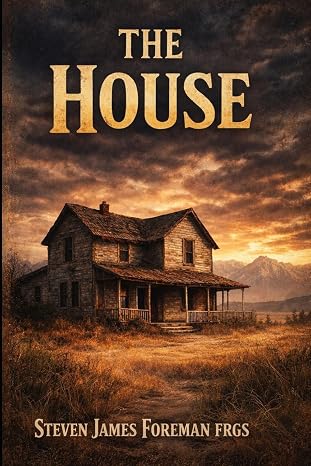
THE HOUSE
A remote farmhouse.
An unused cellar.
Something waiting in the dark.
Randy and Julia think they’ve found the perfect escape from modern life when they buy an old farmhouse outside Helena, Montana.
Surrounded by open ranch land and distant mountains, the house promises quiet, privacy, and a new beginning.
Soon after moving in, strange tensions grow between them.
The air inside the house carries a faint metallic smell no one can explain.
Because beneath the farmhouse, hidden under the cellar floor, something ancient has been waiting for a very long time.
***
A chilling slow-burn horror story blending psychological dread with cosmic terror, The House what happens when an ordinary home becomes the doorway to something unknowable.
Perfect for readers who enjoy: Haunted house horror, Cosmic horror in the tradition of H. P. Lovecraft, Slow-building psychological suspense and Rural isolation settings like The Shining and The Amityville Horror
Some houses are haunted.
Others are far worse.
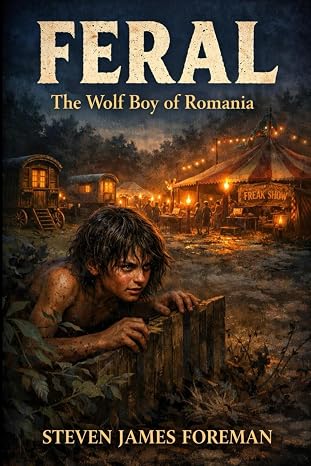
FERAL
Abandoned as a child in a forest of northern Romania, Ciprian survived against all the odds.
Raised by wolves, shaped by hunger and instinct, he became something not wholly human nor entirely wild.
Drawn into a travelling fair, he became a spectacle – The Wolf Boy – caged, watched, taunted and laughed at.
But as the fair travelled around the countryside, rumours grew, bodies were found, flesh was missing… something hunted.
***
There have been many stories of children who disappeared into the wild and were later found again, changed in ways that could not be undone, shaped not by human care, but by something older, harsher, and altogether indifferent.
We call them feral children.
This story is not drawn from any single recorded case.
It is pure fiction. Dragged from my own feral imagination, and yet, it is rooted in the same disturbing possibilities.

LAST WILL
Set in Victorian London, The Last Will is a tragic tale of class division, moral decline, and irreversible consequences.
Martha Franklin, the widowed daughter of a respected Crown Court judge, has spent her life travelling the world with her husband, collecting rare and valuable artefacts. After his death, she returns alone to her grand Westminster home, where her vast collection becomes both her legacy and her isolation. Gradually losing her sight, Martha withdraws from society, relying on a small circle of support and her memories of a life once lived fully.
Through her charitable work in London’s East End, Martha becomes acquainted with Billy Sparrow, the son of a hardworking laundress. Intelligent and eager, Billy is hired to read newspapers to her several evenings a week. Over time, a quiet bond forms between them. Martha offers him not only wages, but a glimpse of a wider world—one shaped by knowledge, discipline, and possibility. In contrast, Billy’s life in Whitechapel is defined by poverty, overcrowding, and limited prospects.
As Billy grows older, he is drawn away from this influence by Harry Stein, an older, streetwise boy who introduces him to petty theft and the seductive logic of survival through crime. What begins as minor opportunism gradually hardens into habit. Despite his mother’s warnings and Martha’s steady encouragement, Billy abandons the path offered to him, severing ties with the only environment that fostered his potential.
Driven by ambition and resentment, Billy reveals to Harry the existence of Martha’s valuable collection and the hidden key that grants access to her home. Together, they plan a burglary, believing the old, blind woman to be defenceless. However, when they break into the house, events spiral beyond their control. Martha recognises Billy by voice and calls for help.
The crime, though unplanned, proves devastating. Under the investigation of Chief Inspector Abberline, both boys are arrested and charged. Faced with the full weight of the law, Billy begins to grasp the enormity of his actions: what he once dismissed as small choices have culminated in a fatal act that cannot be undone.
***
The Last Will is not merely a crime story, but a study of how environment, influence, and personal choice intersect. It explores in immersive and historically accurate detail the environments of Victorian Whitechapel and Westminster and the fragile line between opportunity and ruin, and how a single moment—born of fear and poor judgment—can destroy not only a life, but the promise of one.

THE DOLLS OF BYARD’S LEAP
London, 1889. Josiah Franklin, a seasoned auctioneer at Sowerby’s & Sons, is sent to the decaying estate of Byard’s Leap to appraise a most unusual consignment: a vast and unnerving collection of antique dolls.
Their owner, the widowed Mrs. Montague, lives alone in the crumbling house—surrounded by dust, memory, and silence. But the dolls were not hers. They belonged to her cousin Abigail, whose obsession with them spanned continents and decades. From Bengal to Haiti, from Japan to Zanzibar, each doll carries its own secret… and perhaps something more.
As Franklin begins his work, strange occurrences stir within the manor: footsteps in empty halls, whispers behind locked doors, and a flicker of movement in the abandoned east wing. What begins as a professional errand soon becomes a chilling encounter with guilt, madness, and the ghosts of Empire.
***
Told in evocative, immersive prose, The Dolls of Byard’s Leap weaves together colonial history, gothic horror, and supernatural intrigue in a tale that will stay with you long after the last page is turned.
Rich with historical atmosphere and gothic suspense, The Dolls of Byard’s Leap is a haunting mystery in the classic tradition—perfect for fans of M.R. James, Sarah Waters, and The Woman in Black.
FIVE STAR REVIEW:
Reviewed by Sarah Stuart for Readers’ Favorite
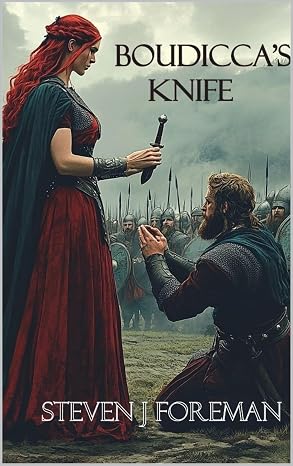
Boudicca’s Knife by Steven James Foreman is a fascinating fantasy. The narrative follows the “life” of a Celtic dagger for a thousand years, its blade variously a knife, a family heirloom, and a ceremonial sword, but always the harbinger of death. A great deal of accurately researched history has gone into the creation of Boudicca’s Knife, but myths are also cleverly woven in. Did D’Artagnan exist? Who was Jack the Ripper? Every scene is brought to vivid life, many told by one man to another. The setting, the way people behave, the names, and the speech transport the reader back to a clearly dated time. The Roman Invasion, King Canute, The French Revolution, both World Wars, Yosemite National Park, and on to Dorset, and a mother’s dream of peace.
Steven James Foreman’s writing captured my interest from the first page. Imagine descriptions of the horror of the Somme; they are here, but this? “The sky above the trenches was painted in the muted hues of dawn, streaks of pink bleeding into the grey.” Boudicca’s Knife is brilliantly convincing, utterly gripping. Most featured owners of the weapon are male, but Emma kills a man she fears, and Julie is forced to use it against a man she loves. The executioner, who operated the French guillotine, steps off the page; a man taking lives for a living, who refused to kill his king and queen, was honored with a knife. It was dug up by chance, stolen, gifted, inherited, sold to a pawnbroker… A ten-star book to be read in one sitting.
Boudicca’s Knife follows the epic journey of a Celtic dagger, first gifted to a great chieftain by Boudicca, and buried with him after the failed revolt against the Roman Empire by the Iceni.For a thousand years it lay buried—until a Saxon farmer, turning soil near the collapsed tomb, dragged it back into the world.From that moment, the knife carves a path through history. From the Saxons and Vikings to Norman Barons, from the guillotine of Revolutionary France to the East End of London, to the gas-choked trenches of World War One, through the jungles of Vietnam, to the mountains of Yosemite, and back to England—where its story ends, in murder.Stolen, worshipped, gifted and used—the blade passes through the hands of soldiers and sailors, to butchers and barbers, from legionnaires to loners, and museums to murderers.
History woven with fiction, or the reverse; either way, Boudicca’s Knife leaves a trail of mystery, mayhem and murder through two thousand years.

FROM THE EAST END TO EAST AFRICA
Steve Foreman, former Professional Soldier, Security Operative, Mountain Leader, and Adventurer, arrived in Tanzania in 1992, when that country was on the cusp of great change, emerging from over a decade of self-imposed near isolation. In this lively memoir, he captures brilliantly the atmosphere of analogue East Africa, a more innocent age before mass global travel, when land-line telephones lines barely existed (let alone mobiles) and the Lonely Planet Travel guide to Tanzania wasn’t even imagined. In bracingly unaffected prose, he captures the realities of Africa in those days: navigating officialdom, trying to get involved in wildlife conservation, pursuing every possibility to find a way to make a life in such an impossibly beautiful and challenging place.
This book will enchant readers with its refreshing take on life in the bush, searching for the endangered rhino and combatting poaching, with long journeys on terrible or non-existent roads to remote places. Quite apart from his extraordinary adventures and the great characters he describes along the way, Steve also has a real gift for wonderful descriptive passages of the beauty of Africa, the early morning outings on safari, the dust, the light, the smells and of course the excitement of encountering its incredible wildlife.
This book is a hymn perhaps to a lost age of Africa, whose digital revolution has now catapulted it into a different world to the one Steve first found, but which still retains the magic that he captures so eloquently. Above all, it is an inspiring story of a man from the East End who fell in love with nature as a child and never could shake off that African dream, which is still a vital message for anybody today with that explorer’s spirit.”
REVIEWED BY: Reggie Heyworth: Tanzania Rhino Conservation Project leader, Frankfurt Zoological Society 1992 to 1995.
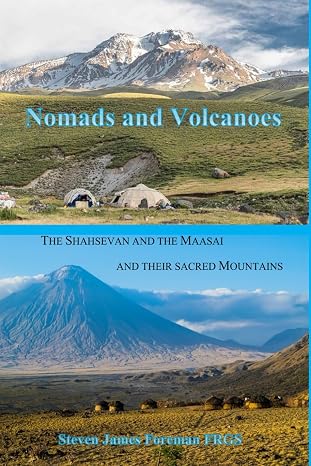
NOMADS AND VOLCANOES:
THE SHAHSEVAN AND THE MAASAI – AND THEIR SACRED MOUNTAINS
A personal experience and observations of the Shahsevan Nomads of Azerbaijan and the Maasai of Tanzania.
In 1973, Steve Foreman was a member of a British Army expedition that travelled by road from Berlin, West Germany to Azerbaijan in Northern Iran, to climb Mount Kuh es Sabalan.
Sabalan, an extinct volcano, is sacred to many people of that region, including the Shahsevan nomads who migrate there with their livestock in the summer months.
Following the ascent of Mount Sabalan, Steve and his colleagues had the wonderful opportunity to spend time with a Shahsevan family, who were camped on a plateau at an altitude of around 8000 ft on the flanks of the mountain, and where they interacted with the people and experienced the food, music, and many daily activities of nomadic life.
20 years later and around 5000 kilometres distant, Steve was working in Tanzania as safari guide and camp manager.
During this time, he became very intimate with the Maasai people who lived in a manyatta out on the Maasai Steppe, in the Great Rift Valley.
He spent time with the warriors, learned much about their culture and lifestyle, and became so immersed in their daily lives that he was made an honorary warrior, invited to stay overnight in the manyatta and to take a Maasai ‘girlfriend’.
Ol Doinyo Lengai is one of the chain of volcanoes in the Rift Valley, and the only one that is active. The name translates to Mountain of God in the Maasai language, and is sacred to the Maasai people, who believe the deity lives on the summit.
Steve climbed the mountain with his son, Zak and two Maasai warriors, an incredibly unique experience for all four.
Along with the two main themes of this book, Steve relates how he became very ill from consuming unpasteurized milk and cows’ blood and had to be evacuated to Nairobi, by road, for treatment. He also leads, along with Maasai camel herders, a tough seven-day camel trek along the Rift Valley to Lake Natron, passing Ol Doinyo Lengai along the way.
In this lively and often humorous memoir, Steve describes the lifestyle and culture of both nomadic groups and concludes that time and distance hardly separated the close similarities of each.
TALES OF THE UNACCEPTED: VOLUMES 1 AND 2
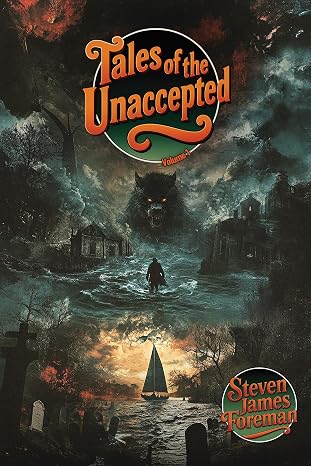
Tales of what? Yes, The Unaccepted! Now, that was unexpected, eh?
When submitted to mainstream publishers, 90% of the stories in these books were deemed unacceptable, because they did not fit neatly into a ‘genre’ box; tied off with a lovely ribbon labelled ‘Sci-Fi’ or ‘Apocalyptic’ or ‘Paranormal’ or ‘Gothic Horror’ or ‘Lovecraftian’ or whatever.
They are indeed hard to define, because I tend to think and write ‘outside the box’, letting my imagination off the leash and run a bit free.
However, many of the tales in these volumes were published in independent e-Zines and are reproduced here.
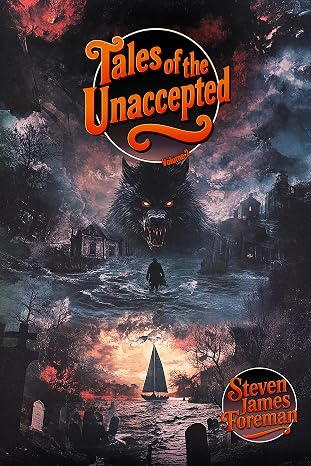
Each tale of mystery, mayhem and murder in this second volume – the spooky, the sardonic and the downright strange – carries within it a unique blend of narratives, characters, and themes that challenge conventional storytelling.
By defying the constraints of traditional genres, these stories offer readers a fresh and unorthodox perspective, inviting them to step beyond the familiar and explore the weird, the ridiculous, the unbelievable and the unacceptable.
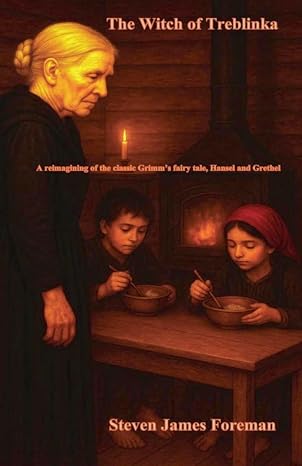
THE WITCH OF TREBLINKA
The Witch of Treblinka is a bold reimagining of the Brothers Grimm’s Hansel and Gretel, reframed through the lens of twentieth-century atrocity. Set against the backdrop of World War II, this haunting novel traces the journey of a Roma Gypsy family as they flee the tightening grip of Nazi persecution across Bukovina, the Carpathian Mountains, and the ancient forests of eastern Poland.
When their mother dies, young Hansel and Gretel are left vulnerable to the will of a faltering father and his ruthless new wife. Abandoned in the vast Bialowieża Forest, the children confront not just wilderness and hunger, but the monstrous legacy of war itself. Deep within the trees, they encounter a figure whose name is spoken in dread – the Witch of Treblinka.***
Weaving together elements of folklore and historical fact, The Witch of Treblinka is a story of endurance and terror, of innocence undone and reclaimed. It is a meditation on memory, myth, and the darkness at the heart of human cruelty, rendered in vivid prose and grounded in the forgotten histories of Roma suffering during the Holocaust.

THE VALLEY OF VOLCANOES: CLIMBS IN EAST AFRICA
A Beginners guide to climbing mountains in the Rift Valley of East Africa. The most famous of all volcanoes in the Rift Valley of East Africa is Mount Kilimanjaro; but there are a few other high mountains to climb too: these are Mount Meru, Mount Elgon, Mount Hanang and the active volcano, Ol Doinyo Lengai. Although these are non-technical ascents (i.e. not requiring harnesses, ropes, crampons, etc.,), make no mistake; these are real ‘climbs’ on real mountains and not mere strolls up big hills.This little book gives a Mountain Leader’s insight to the climbs and shows inexperienced or first-time climbers what the tour company glossy brochures do not, and helps them properly prepare for what to expect… blow-by-blow, warts and all!
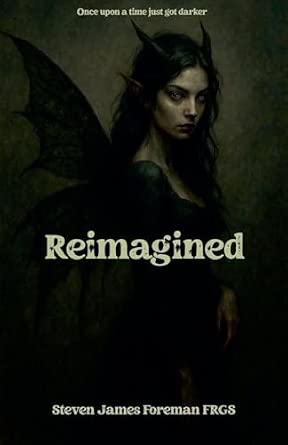
REIMAGINED
“Once upon a time just got a lot darker.”
The fairy tales you thought you knew… now twisted into the world you live in.
No glass slippers. No fairy godmother. No magic.
Here, the beasts walk city streets, the wolves stalk dim alleyways, and the magic is nothing more than the lies we tell ourselves.
Thirteen timeless tales- reborn with modern settings, sharper edges, and a shadow that lingers long after the last page.
Beauty and the Beast – Cinderella – Rapunzel – Sleeping Beauty – The Little Match Girl – The Pied Piper – The Snow Queen – The Three Billy Goats Gruff – The Ugly Duckling – The Three Little Men in the Woods – Death’s Messengers – Hansel and Gretel – Little Red Riding Hood
Familiar stories. Darker paths. No way back.
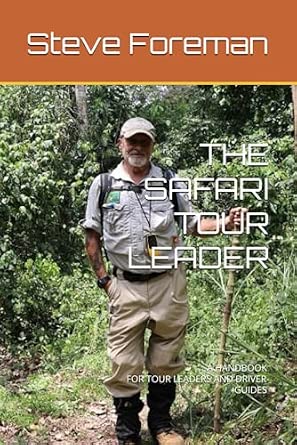
THE SAFARI TOUR LEADER: A HANDBOOK FOR TOUR LEADERS AND DRIVER-GUIDES CONDUCTING SAFARIS IN EAST AFRICA
This handbook is designed to improve and enhance the knowledge and professionalism of International Tour Leaders and National Driver-Guides conducting photographic safaris in East Africa.
It comprises the fundamental yet essential knowledge required to work skillfully and professionally with safari clients in East Africa and beyond, ensuring their safety, comfort, and satisfaction.
The better the trip, the bigger the tip!
The subjects covered include Meeting and transporting clients; handling luggage, procedures at airports, hotels, and park entrances, etc.; vehicle knowledge, daily checks, servicing, on and off-road driving advice, generic Codes of Conduct, wildlife terminology, behavior, and interpretation.
For those tour leaders and guides who wish to progress beyond guiding vehicle safaris, there are modules on conducting camping and walking safaris. These include interpreting flora and fauna on foot, group leadership skills, wildlife confrontation, emergency evacuation from the bush, etc.

